Skip to content
Their First Words

Home › Best for › Babies

Under one

The best first words app for babies — and why it’s for you, not them (2026)

Under one, the guidance is simple: no screen time, and lots of talking. So the best first-words “app” for a baby is a prompt for the parent — a way to know which words to say, in which language — never something the baby watches. Here is what that looks like.

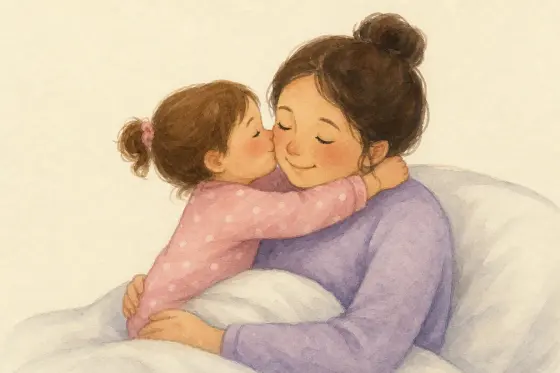
The illustration on the mama card

We make Their First Words, so this is our own comparison — written by the two parents who build it, not by a reviewer. The facts about every other app were checked on October 2, 2026 against their store listings and websites, and the sources are listed at the end. Prices are US prices and change. Where another app is the better choice for your family, this page says so.

The short answer

If you only read this part.

  • The honest answer: no app for the baby. The WHO recommends no screen time under one; the AAP says children under eighteen months learn from real-world interaction, with video chat the one exception.1, 2
  • For you: a board book, the free CDC milestone app to know what to expect, and a word list in the language you want the baby to hear.
  • If that word list is an app: ours, used as a prompt book — a native voice for you to copy, then the phone goes behind your back. Free, no account.
  • Video: not yet. From eighteen months, together and briefly.3

The picks at a glance

Who each one is for.

AppBest forPriceWorks on
Paper cards and board booksPaper cards and board booksThe whole first yearA few dollars, or free: our printable cards are the 75 free words and 35 free phrases in eight languagesA table, a highchair, a lap
CDC’s Milestone TrackerCDC’s Milestone TrackerKnowing what to expect, month by monthFreeiPhone, iPad, Android
Their First WordsTheir First WordsoursA prompt list with a native voice, in eight languages$9.99 once for everything; no subscriptioniPhone, iPad, Android
Little PimLittle PimLater — a gentle video in twelve languages, from eighteen months, togetherSubscription: $9.99 a month or $69.99 a year; free trialiPhone and iPad (iOS 15+), web, and other devices the maker lists

Prices are US store prices on the day they were checked (October 2, 2026); the store is the authority for today’s price.

How we chose

The yardstick, out loud.

  • It respects the guidance: nothing for a baby to watch.1, 2
  • It makes the parent talk more — naming, narrating, singing — because that is what grows words.4, 6
  • It costs nothing, or nearly, and sells no subscription to the parent of a four-month-old.
  • It helps a bilingual parent say the word right in the language they are shakier in.

We rank by fit for the family in the title, not by who made the app. Their First Words is on this list because it belongs here for some of these families and not for others, and the page says which.

The picks

One at a time, honestly.

1 of 4

Paper cards and board books

Best for: The whole first year

Price A few dollars, or free: our printable cards are the 75 free words and 35 free phrases in eight languagesWorks on A table, a highchair, a lapAges From birthLanguages Whatever you say out loud

A board book is the best language technology ever shipped for a baby: it is chewable, it costs a few dollars, and it makes you talk. Point and name, every page, in whichever language you want the baby to hear; babies learn the sounds of a language from a live person, not from a recording.4 Our printables give you the 75 free words and 35 free phrases as paper cards in eight languages if you want a set by the changing table.

2 of 4

CDC’s Milestone Tracker

Best for: Knowing what to expect, month by month

Price FreeWorks on iPhone, iPad, AndroidAges 2 months to 5 yearsLanguages English and Spanish

Free, from the CDC, in English and Spanish: illustrated milestone checklists from two months to five years, tips for each age, and what to do if something is late. It collects nothing that identifies you or your child. It is for you, not the baby.

Worth knowing: It is not a screening tool; the CDC says so itself. Concerns go to your pediatrician, and the free early-intervention evaluation needs no referral.7

3 of 4

Their First Wordsours

Best for: A prompt list with a native voice, in eight languages

Price $9.99 once for everything; no subscriptionWorks on iPhone, iPad, AndroidAges 0–5, in three parent-chosen stages (phrases are not split by stage)Languages English, Spanish, French, Portuguese, German, Italian, Korean and Russian on every card (the app’s own screens are in English)

Used for a baby, it is a prompt book: you look at the picture, tap to hear a native voice say mama or leche or 우유, then say it to your baby with the phone out of sight. The First Words stage holds the 25 free words made for 0–24 months — the ones babies tend to say first — in all eight languages, with a woman’s and a man’s voice. No account, no ads, nothing streams.

Worth knowing: We make it, and we want to be clear: it is not for the baby to look at. The research on baby vocabulary videos found no learning from the screen and real learning from parents saying the same words in daily life.5 From 18–24 months, a card can be shared, briefly, in your hands.3

4 of 4

Little Pim

Best for: Later — a gentle video in twelve languages, from eighteen months, together

Price Subscription: $9.99 a month or $69.99 a year; free trialWorks on iPhone and iPad (iOS 15+), web, and other devices the maker listsAges Babies, toddlers and pre-K — “under the age of 6,” as the maker puts itLanguages 12: Spanish, French, English, Mandarin, Italian, German, Japanese, Arabic, Hebrew, Russian, Korean, Portuguese

Short immersion videos for babies and toddlers in twelve languages. Parents ask about it for infants because it markets to them, and that is why it is here: as the one to wait for. From eighteen months, watched together with the words repeated afterwards, it can be part of a bilingual home; some libraries offer it free.

Worth knowing: Under eighteen months the guidance is no video but video chat, and the controlled research says the video itself teaches little.2, 3, 5

In fairness

Where Their First Words falls short for this family.

  • It is an app, and under one the right amount of app in front of a baby is none. We built the First Words stage for the parent’s use, and we would rather you print the cards.
  • It has no lullabies, no baby signs and no milestone tracker; it is words and phrases only.

What to do

This week.

  1. Narrate. Name what the baby looks at, in full sentences, in the language you want them to have; how much and how well a baby is talked to predicts vocabulary years later.6
  2. Read one board book a day — the same one, if the baby likes it.
  3. Install the CDC milestone app and look at the next checkpoint, so you know what is ordinary.
  4. Video-call the grandparents; the AAP treats it as relationship time.2
  5. If a word list helps you, print ours or open the free set — and keep the phone behind your back.

Questions

What parents ask.

Can a six-month-old learn words from an app?

No. Nine-month-olds learned the sounds of a new language from a person in the room and nothing measurable from identical video or audio.4 What a six-month-old learns from is you.

When do babies say their first words?

Around the first birthday, with a wide normal range; our first-words guide has the milestones and the sources.

Is background TV a problem for a baby?

The AAP links background television to lower language skills: it cuts the number of words a baby hears from you.8

What about Ms. Rachel for babies?

Her videos are warm and slow and parents love them, and the same guidance applies: under eighteen months, screens are not how a baby learns to talk. Save them for later, and watch together.1, 2, 3

Head to head: Their First Words vs Little Pim.

What this is based on

Sources

  1. World Health Organization (2019). To grow up healthy, children need to sit less and play more — no screen time under one; none recommended for sedentary one-year-olds; at most an hour a day from two to four, and less is better. who.int
  2. American Academy of Pediatrics (2026). Helping kids thrive in a digital world: the AAP policy explained — infants under 18 months learn best from real-world interaction; watch and play alongside your child; favor conversation over designs that prolong engagement; video chat with family is relationship time. healthychildren.org
  3. American Academy of Pediatrics (2016). Media and Young Minds. Pediatrics, 138(5) — avoid screen media other than video chat under 18 months; from 18 to 24 months choose high-quality content and use it together with the child. publications.aap.org
  4. Kuhl, P. K., Tsao, F.-M. & Liu, H.-M. (2003). Foreign-language experience in infancy: effects of short-term exposure and social interaction on phonetic learning. PNAS, 100(15), 9096–9101. pnas.org
  5. DeLoache, J. S., Chiong, C., Sharp, K., Vanderborght, M., Troseth, G. L., Strouse, G. A. & O’Doherty, K. (2010). Do babies learn from baby media? Psychological Science, 21(11), 1570–1574. doi:10.1177/0956797610384145
  6. Rowe, M. L. (2012). A longitudinal investigation of the role of quantity and quality of child-directed speech in vocabulary development. Child Development, 83(5), 1762–1774. doi:10.1111/j.1467-8624.2012.01805.x
  7. Centers for Disease Control and Prevention, Concerned about your child’s development? — talk with the doctor, ask about screening, and call your state’s early-intervention program for a free evaluation; no referral needed. cdc.gov
  8. American Academy of Pediatrics (2024). Screen time for infants (Q&A) — children under two learn best from exploring and from people; background television is linked to lower language skills. aap.org
  9. Centers for Disease Control and Prevention, CDC’s Milestone Tracker app. cdc.gov
  10. Little Pim, home page — the twelve languages, the method, 360 words and phrases per language, prices, ad-free. littlepim.com
  11. Apple App Store, Little Pim Video — subscription prices, age band, privacy label, last update. apps.apple.com
  12. Mango Languages support, Little Pim — library access. support.mangolanguages.com
  13. Their First Words, FAQ — price, free set, languages, offline use, accounts. theirfirstwords.org/faq

Facts about other apps were checked on October 2, 2026 against the sources above. Store prices are US prices on that day; they change, and the store is the authority for today’s price.

More guides

Other families.

Simple Words, Special Moments

Start with one word.

75 words and 35 phrases are free, forever, with both voices. One $9.99 purchase opens the rest of the 1,000+ words and 500+ phrases, in all eight languages at once. No subscription, nothing renews.

No ads, ever Private by design Works offline No account needed Up to 4 children