
The short answer
Most babies say a recognisable first word somewhere around 12 months. Timing varies, but a missed milestone or a concern is worth discussing rather than explaining away. The CDC’s milestone checklists — rewritten in 2022 to describe what most children (about 75%) do by an age, not the average — put it this way: by 12 months a child calls a parent “mama” or “dada” or another special name; by 15 months they try to say one or two words besides mama or dada; by 18 months, three or more; and by 24 months they put two words together, like “more milk.”1
ASHA, the professional body for speech-language pathologists, gives a similar shape: between 19 and 24 months a child typically uses and understands at least 50 different words and starts joining two of them.2
What counts as a word: any sound your child uses consistently to mean one thing. “Ba” for the ball, every time, is a word. Signs are meaningful language; record them separately from spoken words when discussing a spoken-word milestone. “Mama” babbled at the ceiling is not, yet; “mama” said while reaching for you is.
What usually comes first
Talking is the visible end of a long build. Before words, most children go through the same stretch in roughly the same order:
- Cooing, then babbling (around 4 to 9 months) — strings of syllables like “bababa” that sound like the language around them.
- Understanding — by the first birthday most children respond to their name and follow simple, familiar words (“bath,” “bye-bye”) long before they say them.1
- Pointing and showing (around 9 to 12 months) — the child points, holds something up, looks at you and back at it. This is the important one. Joint attention — the two of you looking at the same thing while you name it — is one of the best-documented predictors of early vocabulary.3
Pointing, showing, babbling and understanding give useful information about communication. They do not guarantee that spoken words will follow soon or rule out a delay.9
What helps
The research here is unusually consistent, and none of it involves buying anything.
Talk to them, about what they are looking at
The amount of speech directed to a child — not overheard, not from a screen — predicts their vocabulary and how fast they process words, even after accounting for family background.4 What you say matters too: naming things, varied words, and talk that follows the child’s attention rather than redirecting it.5 The practical version: when your child looks at the dog, say “dog.” When they hold up the cup, say “cup, yes, your cup.” Narrate the small things during routines — the bath, the highchair, the stroller — because those repeat every day, and repetition is how a word sticks.
Answer the attempt, not the accuracy
When your child says “ba” and reaches for the ball, the useful response is “Ball! Here’s the ball,” not a correction. They hear the real word from you in the moment it mattered, which is exactly the input that works.
A live person, not a recording
In a well-known 2003 study, nine-month-old infants exposed to Mandarin by a person in the room learned to hear its sound contrasts; the video and audio groups did not show the same learning on that speech-sound test.6 The result concerns a specific task, not every kind of screen learning. Screen guidance and practical alternatives are covered in our screen-time guide.7, 8
Read the same book again
Toddlers ask for the same book because repetition is the point. Picture books work for the same reason pointing does: two people, one picture, one word, said out loud by someone the child loves.
When to ask your pediatrician
Talk with your child’s doctor about any missed milestone or communication concern. Examples include:
- No gestures. If gestures are limited or your child is not trying to share attention, mention it. Consider gestures alongside understanding and spoken language.1
- Missed language milestones or lost skills. Do not wait for there to be no words. Contact the doctor promptly if words or other skills are lost, and ask about screening and a hearing check.1, 9, 10
Learning more than one language does not cause a language disorder. Assessment should consider all of a child’s languages.11 More on that in the bilingual toddler guide.
Where an app fits, honestly
Nowhere in the list above, and we make one. What a flashcard app can do is hand you the word — a clear picture and a native voice to copy, in a language you may not speak — so that you say it, at the moment your child is looking at the thing. The cards are optional prompts for shared talk, not a treatment or a developmental assessment. If you use ours, the free words are the same ones a first-year child points at anyway: milk, dog, ball, mama.
What this is based on
Sources
- CDC, Learn the Signs. Act Early. Developmental milestone checklists (revised 2022). cdc.gov/act-early/milestones
- American Speech-Language-Hearing Association, Communication milestones: 19 to 24 months. asha.org
- Tomasello, M. & Farrar, M. J. (1986). Joint attention and early language. Child Development, 57(6), 1454–1463. doi:10.2307/1130423
- Weisleder, A. & Fernald, A. (2013). Talking to children matters: early language experience strengthens processing and builds vocabulary. Psychological Science, 24(11), 2143–2152. doi:10.1177/0956797613488145
- Rowe, M. L. (2012). A longitudinal investigation of the role of quantity and quality of child-directed speech in vocabulary development. Child Development, 83(5), 1762–1774. doi:10.1111/j.1467-8624.2012.01805.x
- Kuhl, P. K., Tsao, F.-M. & Liu, H.-M. (2003). Foreign-language experience in infancy: effects of short-term exposure and social interaction on phonetic learning. PNAS, 100(15), 9096–9101. pnas.org
- World Health Organization (2019). Guidelines on physical activity, sedentary behaviour and sleep for children under 5 years of age. who.int
- American Academy of Pediatrics, Media and children — family media guidance. aap.org
- ASHA, Late Language Emergence: receptive and expressive language and uncertainty. asha.org
- NIDCD, Speech and Language Developmental Milestones: assessment and hearing checks. nidcd.nih.gov
- AAP and ASHA, Young Children Learning Multiple Languages: Parent FAQs. healthychildren.org
More guides
Keep reading.
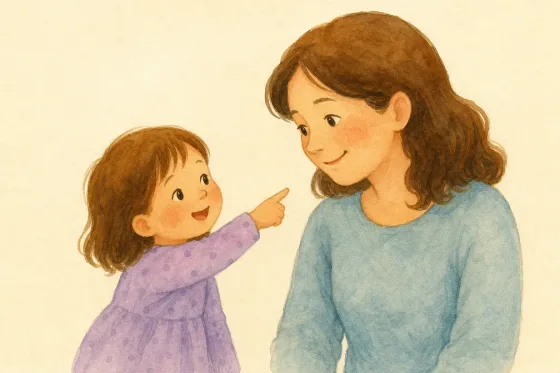 Raising a bilingual toddler: what the research says.What the research says about two languages at home, and how to make it work.Read the guide · 7 min ›
 How to use flashcards with a toddler (without turning it into a quiz).Five suggestions for sharing cards without a quiz.Read the guide · 5 min ›
 Is my toddler a late talker? When to ask for help.Word counts can raise a concern; they cannot tell you whether your child needs support. Here is who to ask.Read the guide · 5 min ›
 Does a second language delay a child’s speech?No — and here are the studies to hand to whoever asked.Read the guide · 6 min ›
 How many words should an 18-month-old say?What the 18-month checklist can tell you, what it cannot, and when to ask.Read the guide · 3 min ›
 Screen time under two: what the research actually says.Current guidance, limits of the research, and how it applies to our app.Read the guide · 3 min ›
 A first words list by age.The categories that often come first across languages, and roughly when, from 12 months to 3.Read the guide · 7 min ›
 From a mealtime word to a useful phrase.Use four real cards, playable audio, and one printable sheet during a meal.Read the guide · 4 min ›
- A two-language card routine for an ordinary meal.A small English–Spanish meal routine with actual cards and recordings.Read the guide · 5 min ›
 First Spanish words for toddlers: 75 to start with.Seventy-five words by age and topic, each with a native voice to copy — and which five to start with.Read the guide · 6 min ›
 One little picnic: name it, count it, sort it.Four Spanish cards to hear and print, a count, a sort, and one short film — for one ordinary outing.Read the guide · 6 min ›
Simple Words, Special Moments
Start with one word.
75 words and 35 phrases are free, forever, with both voices. One $9.99 purchase opens the rest of the 1,000+ words and 500+ phrases, in all eight languages at once. No subscription, nothing renews.