Skip to content
Their First Words

Home › Best for › Korean

우리 아이 첫 한국어

The best Korean app for toddlers (2026)

For a family raising a toddler with Korean at home — grandparents in Seoul, parents whose own Korean is rusty — the app store has surprisingly little. Here is what exists, what is actually made for a two-year-old, and where ours stands, limits included.

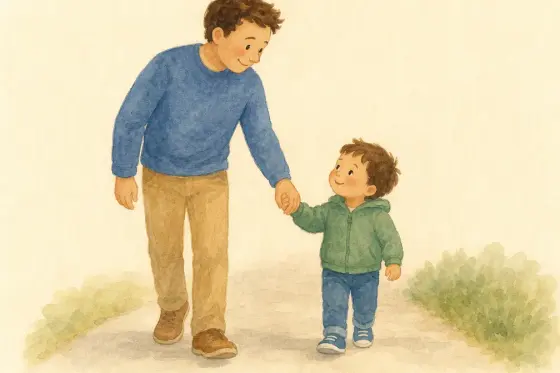
The illustration on the “Hold my hand” phrase card

We make Their First Words, so this is our own comparison — written by the two parents who build it, not by a reviewer. The facts about every other app were checked on October 2, 2026 against their store listings and websites, and the sources are listed at the end. Prices are US prices and change. Where another app is the better choice for your family, this page says so.

The short answer

If you only read this part.

  • For first words and phrases in Korean, from the first year: Their First Words — every card in Korean with a female and a male native voice, $9.99 once; 75 words and 35 phrases free.
  • For a school-age child who wants a course: Dinolingo Korean, ages 2–14, $199 a year.
  • For short videos: Little Pim Korean, $69.99 a year, or free through some libraries.
  • For $3.99: Gus on the Go: Korean — about 90 words, but unchanged since 2018 when we checked.
  • For Hangul: none of these. Letters come later, and from a different kind of app.

The picks at a glance

Who each one is for.

AppBest forPriceWorks on
Their First WordsTheir First WordsoursFirst words and everyday phrases in Korean, said by you$9.99 once for everything; no subscriptioniPhone, iPad, Android
DinolingoDinolingoA school-age child who wants a Korean courseSubscription: $19 a month or $199 a year; 7-day free trialWeb browser, iPhone, iPad, Android
Little PimLittle PimShort Korean videos, from eighteen months, watched togetherSubscription: $9.99 a month or $69.99 a year; free trialiPhone and iPad (iOS 15+), web, and other devices the maker lists
Gus on the GoGus on the GoA $3.99 look at Korean$3.99 once per language appiPhone, iPad, Mac (M1+); Android for some languages
Paper cards and board booksPaper cards and board booksThe grandparents’ visitA few dollars, or free: our printable cards are the 75 free words and 35 free phrases in eight languagesA table, a highchair, a lap

Prices are US store prices on the day they were checked (October 2, 2026); the store is the authority for today’s price.

How we chose

The yardstick, out loud.

  • Native Korean voices, in the Seoul standard a child will hear from grandparents and on television.
  • Made for the age: a parent holding the phone and saying the word, for the under-threes.2, 3
  • Korean that is right for a child: polite endings a toddler will actually be taught, and the family words that change with who is speaking.
  • Maintained. A Korean app that has not been touched in years is a risk on a new phone.
  • Honest pricing, no ads, offline.

We rank by fit for the family in the title, not by who made the app. Their First Words is on this list because it belongs here for some of these families and not for others, and the page says which.

The picks

One at a time, honestly.

1 of 5

Their First Wordsours

Best for: First words and everyday phrases in Korean, said by you

Price $9.99 once for everything; no subscriptionWorks on iPhone, iPad, AndroidAges 0–5, in three parent-chosen stages (phrases are not split by stage)Languages English, Spanish, French, Portuguese, German, Italian, Korean and Russian on every card (the app’s own screens are in English)

Every one of 1,000+ words and 500+ phrases is on the same card in Korean and English (and six more languages), spoken by a woman and a man who are native speakers, in the Seoul standard. The phrases are the ones a toddler is taught to say — 더 주세요, 다 했어요, 고마워요 — with the polite endings a child would use, and the family ones a child would say to a parent, like 내 손 잡아. The family words follow Korean rather than English: for older brother the female voice says 오빠 and the male voice says 형, because that is who would be saying it.

You tap, hear the native voice, then say it to your child; the app is the prop, you are the teacher.2 75 words and 35 phrases are free in Korean with no account; $9.99 once opens everything, offline. The Korean page lets you hear real cards first, and the same cards are free to print.

Worth knowing: We make it. It teaches spoken words and phrases only — no Hangul, no reading. The app’s menus are in English, so a grandparent who reads only Korean needs you to set it up. Seoul standard only, no dialects.

2 of 5

Dinolingo

Best for: A school-age child who wants a Korean course

Price Subscription: $19 a month or $199 a year; 7-day free trialWorks on Web browser, iPhone, iPad, AndroidAges 2–14, as the maker statesLanguages 50 languages, including all eight of ours and many more (Mandarin, Hindi, Arabic, Japanese…)

A full course — videos, games, songs, books, worksheets — in Korean and forty-nine other languages, for ages 2 to 14, in a browser or on phones, for $19 a month or $199 a year after a seven-day trial. For an eight-year-old who wants structure and progress, this is the one.

Worth knowing: Priced for a serious course, and the youngest share a design with ten-year-olds.

3 of 5

Little Pim

Best for: Short Korean videos, from eighteen months, watched together

Price Subscription: $9.99 a month or $69.99 a year; free trialWorks on iPhone and iPad (iOS 15+), web, and other devices the maker listsAges Babies, toddlers and pre-K — “under the age of 6,” as the maker puts itLanguages 12: Spanish, French, English, Mandarin, Italian, German, Japanese, Arabic, Hebrew, Russian, Korean, Portuguese

Five-minute immersion videos narrated by native speakers, built around 360 foundational words and phrases, with printable parent guides. $9.99 a month or $69.99 a year, and some US libraries offer it free through Mango Languages.

Worth knowing: It is video. Under eighteen months the guidance is none but video chat — which, with Korean grandparents, is the best Korean lesson there is.3

4 of 5

Gus on the Go

Best for: A $3.99 look at Korean

Price $3.99 once per language appWorks on iPhone, iPad, Mac (M1+); Android for some languagesAges Apple’s “Made for Ages 0–5” band; the maker gives no rangeLanguages One app per language — Spanish, French, German, Italian, Portuguese, Russian, Korean and about a dozen more

About 90 Korean words and ten activities with Gus the owl, no ads, no purchases, no tracking. For $3.99 it is a harmless way to see whether a three-year-old wants more.

Worth knowing: Its App Store listing showed no update since March 2018 when we checked. Ninety words is a toe in the water.

5 of 5

Paper cards and board books

Best for: The grandparents’ visit

Price A few dollars, or free: our printable cards are the 75 free words and 35 free phrases in eight languagesWorks on A table, a highchair, a lapAges From birthLanguages Whatever you say out loud

A stack of cards on the table and a halmeoni who says the word is better than any app. Our Korean printables are the 75 free words and 35 free phrases, four to a sheet, in Hangul — free to print, and the grandparents can keep them.

In fairness

Where Their First Words falls short for this family.

  • No Hangul. The app says words; it does not teach reading or writing them.
  • English menus. The cards are in Korean, but a Korean-only grandparent cannot drive the app without you.
  • One standard. Seoul standard only — no dialects, and no second version of a phrase for a different listener.
  • No songs or stories. For 곰 세 마리 you need a different app — or your own voice.

What to do

This week.

  1. Pick the ten words your own parents said to you first — 엄마, 아빠, 우유, 신발, 공 — and say them in Korean at every meal this week.
  2. Open the free set, choose Korean for your child’s profile, and listen to both voices on one card before you say it yourself.
  3. Book a weekly video call with the Korean-speaking grandparents and let them name things on the screen; the AAP counts it as relationship time, not screen time.3
  4. Print the Korean cards and send a set to Seoul so the grandparents use the same words you do.
  5. Keep Korean at home even once daycare is in English; two languages do not confuse a toddler, and the home language is the foundation.1

Questions

What parents ask.

Will Korean at home delay my child’s English?

No. ASHA’s position is that more than one language does not cause delay or confusion, and a true disorder shows in both languages.1 Count words in Korean and English together.

Does any app teach a toddler Hangul?

Not these. Letter-tracing apps exist for older preschoolers; for a toddler the job is spoken words, and reading can wait.

Which Korean does Their First Words use?

Seoul standard, with the polite endings a child is taught, spoken by one female and one male native voice. The family words follow the speaker: 오빠 from the female voice, 형 from the male.

What about Pinkfong and Pororo?

Korean children’s television, free on YouTube, and genuinely Korean. The same screen guidance applies as for any video: not before eighteen months, then together and briefly.3, 4

Head to head: Their First Words vs Dinolingo · Their First Words vs Little Pim.

What this is based on

Sources

  1. American Speech-Language-Hearing Association, Learning more than one language — using more than one language does not confuse children or cause delays; a true disorder shows up in all the languages a child uses. asha.org
  2. Kuhl, P. K., Tsao, F.-M. & Liu, H.-M. (2003). Foreign-language experience in infancy: effects of short-term exposure and social interaction on phonetic learning. PNAS, 100(15), 9096–9101. pnas.org
  3. American Academy of Pediatrics (2026). Helping kids thrive in a digital world: the AAP policy explained — infants under 18 months learn best from real-world interaction; watch and play alongside your child; favor conversation over designs that prolong engagement; video chat with family is relationship time. healthychildren.org
  4. World Health Organization (2019). To grow up healthy, children need to sit less and play more — no screen time under one; none recommended for sedentary one-year-olds; at most an hour a day from two to four, and less is better. who.int
  5. Dinolingo, Pricing — plans, trial, 50 languages, ages 2–14, platforms, ad-free. dinolingo.com/pricing
  6. Little Pim, home page — the twelve languages, the method, 360 words and phrases per language, prices, ad-free. littlepim.com
  7. Apple App Store, Little Pim Video — subscription prices, age band, privacy label, last update. apps.apple.com
  8. Mango Languages support, Little Pim — library access. support.mangolanguages.com
  9. Apple App Store, Gus on the Go: Spanish — price, ~90 words, 10 activities, no ads or tracking, other language editions, last update. apps.apple.com
  10. Apple App Store, Gus on the Go: Korean — price and last update. apps.apple.com
  11. Their First Words, FAQ — price, free set, languages, offline use, accounts. theirfirstwords.org/faq

Facts about other apps were checked on October 2, 2026 against the sources above. Store prices are US prices on that day; they change, and the store is the authority for today’s price.

More guides

Other families.

Simple Words, Special Moments

Start with one word.

75 words and 35 phrases are free, forever, with both voices. One $9.99 purchase opens the rest of the 1,000+ words and 500+ phrases, in all eight languages at once. No subscription, nothing renews.

No ads, ever Private by design Works offline No account needed Up to 4 children