Minutes in the quieter language
How much exposure does a bilingual toddler need?
Daycare is in English, dinner is in Portuguese, and you are wondering whether that is enough. There is no exact number: researchers start counting a child as bilingual at ten to twenty-five percent of the day in each language, and more is better. Here is what else matters — and which language to protect.
No magic number, but a floor
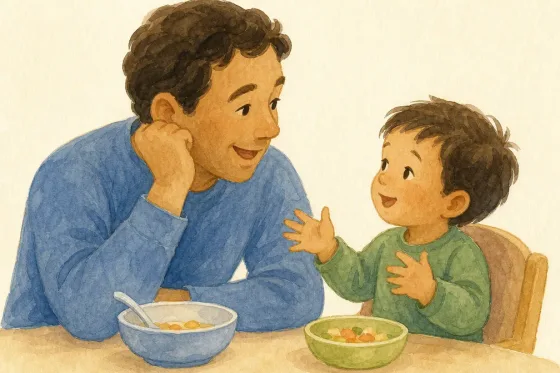
Parents ask for a percentage, and the research offers a floor rather than a target. Researchers generally consider a child bilingual when each language makes up at least ten to twenty-five percent of what the child hears. They are careful to add that this much by no means guarantees a child will use both languages well, and that a language heard only now and then, such as on a grandparent’s weekend visit, is unlikely to stick on its own.1
Above that floor, more is better in a fairly direct way. In a study of twenty-five babies and toddlers aged eight to thirty months, the share of a child’s words in each language closely tracked the share of that language in what they heard; the link did not hold up for children who heard little Spanish.2 A later study of Spanish–English toddlers found the same pattern: vocabulary in each language grew with the amount of that language the child was exposed to.3
The practical version. More of the day in a language means more words in it, and the link is weakest for a language heard only a little.2, 3 A home language that lives only at dinner has less to build on than one heard at breakfast, at bath time and on calls with a grandparent. The minutes are what you can change.
Who is talking matters too
Hours are not the whole story. When researchers studied twenty-nine Spanish–English two-year-olds using diaries their mothers kept, the relative amount of each language predicted how well each one was coming along. For English, two more things mattered: the number of different people the child heard it from, and the share of it that came from native speakers.4 None of that asks you to speak a language you are unsure of; the AAP’s advice is to use the language you are most comfortable in.9 A grandparent, a caregiver and a neighbor each add something one parent alone cannot: another voice, another vocabulary, another reason to use the language.
How people talk matters too. In a study of Spanish–English infants at eleven and fourteen months, the amount of one-on-one “parentese” — the warm, slow, high-pitched talk adults fall into with babies — was linked with the children’s vocabulary at two, in each language separately.5 Talk aimed at your child, back and forth over a banana, is the kind that showed up in those scores.
And it needs to be a person. Nine-month-olds who spent a few short sessions with a live Mandarin speaker learned to hear a Mandarin sound contrast; a matched group given the identical material on video or audio did not.6 That was one speech-sound contrast, not every kind of learning, but it fits the rest of this research: the exposure that counted came from people.
The language at risk is the home language
In a survey of 1,899 families with children aged six to ten, in which at least one parent spoke a language other than the majority language, every child spoke the majority language. Speaking the minority language was not universal, and it tracked what parents did at home: the pattern with the best odds was both parents using the minority language, with at most one of them also speaking the majority language. “One parent, one language” turned out to be neither necessary nor sufficient.7
That imbalance is the one to plan around. English, or whatever the community speaks, will arrive through daycare, neighbors, television and school whether or not you work at it. The home language has only the people who speak it. Head Start’s guidance for early educators names home-language support as the foundation for developing English, and the AAP tells parents not to drop the home language when school starts; keeping it will not confuse a child or hold them back at school.8, 9
Where the minutes come from
- The parts of the day you already own. Breakfast, the walk, bath time, the bedtime book. Deciding that these happen in the home language gives it a fixed place rather than a hope.
- Another speaker. A weekly call with a grandparent, a caregiver or babysitter who speaks the language, a playgroup or a Saturday school. Each one is a new voice and a new reason to talk.4
- Talk aimed at your child. Narrate what you are doing, name what they point at, answer the half-word with the whole word. The one-on-one minutes are the ones that showed up in the vocabulary scores.5
- A reply in the home language, even when they answer in English. Answering in English is common, and it shows the home language is being understood. Giving the phrase back in your language keeps it in the conversation.
- Songs, books and stories in the quieter language. They do not replace a person, but they give you and your child shared words to use together.
Keeping track without keeping score
A rough sense of the week is more useful than a daily count. If the home language only happens at dinner, that is perhaps an hour a day out of twelve waking ones, under the floor the research describes. Adding mornings, a weekend day and one extra speaker can double it without anyone feeling drilled. There is no streak to keep; a week with less of the home language is a week, not a verdict.
When to ask for help
Low exposure can explain a small vocabulary in the less-heard language. It does not explain few words in both languages together, or a loss of words, or a child who does not point, gesture or respond to their name. Those deserve the same prompt attention as in any child; our late talker guide explains the steps, and the assessment should consider every language your child hears.9, 10
When the home-language word escapes you
When the word you want in the home language is the one you have half forgotten, Their First Words gives you the picture, the written word and a native voice to copy, in eight languages. It supplies the word; the exposure that counts is you saying it over breakfast.
In short
Questions parents ask.
Is 20 percent exposure enough for a toddler to learn a language?
It is near the low end. Researchers generally count a child as bilingual when each language fills at least ten to twenty-five percent of their language exposure, and they add that this level does not guarantee the child will speak it. The more a language is heard, the larger a toddler’s vocabulary in it tends to be, so twenty percent is a floor to build on, not a target to stop at.
Do both parents need to speak the home language?
No, but it is the pattern with the best odds. In a study of nearly 1,900 families with children aged six to ten, the children most likely to speak the minority language had parents who both used it at home. “One parent, one language” was neither necessary nor sufficient. If only one of you speaks it, that parent’s minutes count for more, and other speakers can add to them.
Do videos or apps count as exposure?
Not in the way a person does. In a well-known study, nine-month-olds learned a speech-sound contrast from a live speaker but not from the same material on video or audio. Recordings can supply a word or a song; the exposure that builds a language comes from people talking with your child.
My toddler understands the home language but answers in English. How do I encourage them to speak it?
Keep speaking it. Understanding comes first, and answering in the majority language is common. Reply in the home language, give the phrase they were reaching for, and add other speakers — relatives, a caregiver, a playgroup — so the language has reasons to be used, not only heard.
What this is based on
Sources
- Byers-Heinlein, K. & Lew-Williams, C. (2013). Bilingualism in the early years: what the science says. LEARNing Landscapes, 7(1), 95–112. PMC6168212
- Pearson, B. Z., Fernández, S. C., Lewedeg, V. & Oller, D. K. (1997). The relation of input factors to lexical learning by bilingual infants. Applied Psycholinguistics, 18(1), 41–58. doi:10.1017/S0142716400009863
- Hoff, E., Core, C., Place, S., Rumiche, R., Señor, M. & Parra, M. (2012). Dual language exposure and early bilingual development. Journal of Child Language, 39(1), 1–27. doi:10.1017/S0305000910000759
- Place, S. & Hoff, E. (2011). Properties of dual language exposure that influence 2-year-olds’ bilingual proficiency. Child Development, 82(6), 1834–1849. doi:10.1111/j.1467-8624.2011.01660.x
- Ramírez-Esparza, N., García-Sierra, A. & Kuhl, P. K. (2017). The impact of early social interactions on later language development in Spanish–English bilingual infants. Child Development, 88(4), 1216–1234. doi:10.1111/cdev.12648
- Kuhl, P. K., Tsao, F.-M. & Liu, H.-M. (2003). Foreign-language experience in infancy: effects of short-term exposure and social interaction on phonetic learning. PNAS, 100(15), 9096–9101. pnas.org
- De Houwer, A. (2007). Parental language input patterns and children’s bilingual use. Applied Psycholinguistics, 28(3), 411–424. doi:10.1017/S0142716407070221
- Office of Head Start (HeadStart.gov), Planned Language Approach — names “Home Language Support as the foundation for developing English language skills.” headstart.gov
- AAP and ASHA, Young Children Learning Multiple Languages: Parent FAQs — use the language you are most comfortable with; keep the home language when school starts; assessment considers every language. healthychildren.org
- CDC, Concerned About Your Child’s Development? — missed milestones, screening and evaluation. cdc.gov
Simple Words, Special Moments
Start with one word.
75 words and 35 phrases are free, forever, with both voices. One $9.99 purchase opens the rest of the 1,000+ words and 500+ phrases, in all eight languages at once. No subscription, nothing renews.
More guides
Keep reading.
 Can I teach my child a language I don’t speak?Why your accent is probably not the worry, what a native speaker adds, and how a few real exchanges a day can start a second language.Read the guide · 8 min ›
 Raising a bilingual toddler: what the research says.Why mixing is normal, how vocabulary grows, and where two languages fit into family life.Read the guide · 7 min ›
 Can a 2-year-old be bilingual? And is mixing languages normal?Why two is not too late, why "más juice" is a good sign, and how to count a bilingual toddler’s words.Read the guide · 7 min ›
Choosing an app? Our guides to the best first words app for bilingual families and the best English app for toddlers with another home language.