Home › Guides › Bilingual at two
Two languages at two
Can a 2-year-old be bilingual? And is mixing languages normal?
A two-year-old asks for “más juice” and a grandparent frowns. Someone says you should have started earlier; someone else says two languages are too many. Both worries have been studied: two is a fine age to start, and mixing is normal.
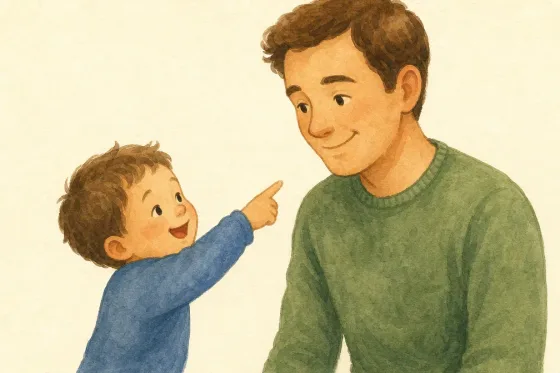
Yes, and they may already be
There are two ways a child ends up with two languages. Some hear both from birth. Others meet a second language at two or three, often when daycare or a new caregiver speaks something different from home. Either route can lead to a child who speaks both; the second group simply begins with one language already under way. The researchers who study this put it plainly: it is never too late to learn a new language, though it gets harder with age.1
So if your two-year-old is starting a second language now, you are not behind. And if your two-year-old has heard two languages all along, the question is usually not whether they can be bilingual but whether the quieter language is getting enough of the day. That question has its own answer in our guide to how much exposure a bilingual toddler needs.
Mixing is not confusion
“Más juice.” “I want agua.” “Appa, look!” A toddler who does this is doing what bilingual speakers of every age do: borrowing the word that comes fastest. Researchers who recorded bilingual children just under and just over two found that the children were clearly able to tell their two languages apart even while they mixed them, and that mixing by itself is not evidence of a muddle.2 A review of the early-bilingualism literature calls code mixing a normal part of bilingual development, and a sign of children’s ingenuity rather than their confusion.1
The American Academy of Pediatrics and the American Speech-Language-Hearing Association say the same thing to parents: mixing grammar or words from both languages is normal and does not mean a child is confused, and most children keep their languages more separate by about age three.3
What to say back. “Más juice” is a request, so answer it: “Sí, más jugo” or “Yes, more juice.” The reply gives the whole phrase in one language without turning a nice moment into a correction.
What about when you mix?
Most bilingual parents mix too. When researchers recorded twenty-four bilingual caregivers playing with their toddlers, every one of them switched languages at least once, some in more than a third of what they said, and the switching showed no sign of harming the children’s word learning; switching inside a sentence was, if anything, linked with larger vocabularies.4 An earlier questionnaire study had found the opposite lean: parents who reported mixing more had children who understood fewer English words at eighteen months, and spoke marginally fewer at two.5
Put those together and the honest reading is: mixing is ordinary, and the evidence of harm is weak and mixed. The AAP’s advice is to use the language you are most comfortable in, because children benefit from as much language as possible.3
Counting words in two languages
A two-year-old’s word count is the number most parents worry over, and for a bilingual child it is easy to get wrong. When forty-seven Spanish–English toddlers aged twenty-two to thirty months were compared with fifty-six toddlers learning English alone, their total vocabulary across both languages grew at about the same rate as the monolingual children’s.6 Counted in either language alone, bilingual children typically know fewer words than monolingual children; counted together, about the same.1
One list with both languages on it gives the real number, and it is useful to bring along if you ever seek an assessment.
What helps at two
A study of twenty-nine Spanish–English two-year-olds, using diaries their mothers kept, found that the share of the day each language filled predicted how well each one was coming along. For English, two more things mattered: how many different people the child heard it from, and how much of it came from native speakers.7 At two, that translates into ordinary choices: a grandparent on a video call, a caregiver who speaks the home language, a playgroup, a Saturday school, a book at bedtime in the quieter language. More people, more minutes.
You do not need to split the languages by parent. The “one parent, one language” rule has been tested and is neither necessary nor sufficient; children who hear both languages from the same bilingual parent often learn both perfectly well.1 Use whatever arrangement gives each language real, regular time.
When to ask for help
Two languages do not cause delay, and a bilingual toddler with few words in both languages combined deserves the same attention as any other toddler with few words.3, 8 Our late talker guide explains what an evaluation looks like; it should cover all your child’s languages, with an interpreter if needed. Ask about any missed milestone, and promptly if words or other skills are lost.9
When you need the word in the other language
Sometimes the word you want in the second language is the one you are least sure of. In Their First Words, the same picture is jugo and then juice with a switch of the language pill, each with a native voice to copy, across eight languages. It is there for the word; the conversation at the table is yours.
In short
Questions parents ask.
Is two too late to start a second language?
No. A child who meets a second language at two or three can become bilingual, just as a child who hears both from birth can; they simply start with one language already under way. Researchers who study early bilingualism say it is never too late to learn a new language, though it does get harder with age. What matters at two is regular, real exposure, not the start date.
My 2-year-old mixes Spanish and English in one sentence. Is that a problem?
No. Mixing words from both languages inside one sentence is a normal part of growing up bilingual, and bilingual adults do it too. Toddlers who mix can still tell their two languages apart. Most children keep the languages more separate by around age three.
Should I stop mixing languages myself?
You do not have to. Nearly all bilingual parents mix at least sometimes. A study that recorded parents playing with their toddlers found no sign that mixing slowed word learning; an earlier questionnaire study linked heavy mixing with smaller vocabularies at eighteen months. The evidence of harm is weak and mixed, and the AAP’s advice is simply to use the language you are most comfortable in.
How many words should a bilingual 2-year-old have?
Count both languages. Added together, bilingual toddlers’ vocabularies grow at about the same rate as monolingual children’s. Counting only one language misses part of what your child knows, which is why an assessment should consider every language your child hears.
What this is based on
Sources
- Byers-Heinlein, K. & Lew-Williams, C. (2013). Bilingualism in the early years: what the science says. LEARNing Landscapes, 7(1), 95–112. PMC6168212
- Genesee, F., Nicoladis, E. & Paradis, J. (1995). Language differentiation in early bilingual development. Journal of Child Language, 22(3), 611–631. doi:10.1017/S0305000900009971
- AAP and ASHA, Young Children Learning Multiple Languages: Parent FAQs — mixing is normal, most children separate the languages by about three, use the language you are most comfortable with. healthychildren.org
- Bail, A., Morini, G. & Newman, R. S. (2015). Look at the gato! Code-switching in speech to toddlers. Journal of Child Language, 42(5), 1073–1101. doi:10.1017/S0305000914000695
- Byers-Heinlein, K. (2013). Parental language mixing: its measurement and the relation of mixed input to young bilingual children’s vocabulary size. Bilingualism: Language and Cognition, 16(1), 32–48. doi:10.1017/S1366728912000120
- Core, C., Hoff, E., Rumiche, R. & Señor, M. (2013). Total and conceptual vocabulary in Spanish–English bilinguals from 22 to 30 months: implications for assessment. Journal of Speech, Language, and Hearing Research, 56(5), 1637–1649. PMID 24023382
- Place, S. & Hoff, E. (2011). Properties of dual language exposure that influence 2-year-olds’ bilingual proficiency. Child Development, 82(6), 1834–1849. doi:10.1111/j.1467-8624.2011.01660.x
- Horn, M., Nationwide Children’s Hospital (2017; updated November 2025). Teaching kids a second language: can it cause a speech delay? nationwidechildrens.org
- CDC, Concerned About Your Child’s Development? — missed milestones, screening and evaluation. cdc.gov
Simple Words, Special Moments
Start with one word.
75 words and 35 phrases are free, forever, with both voices. One $9.99 purchase opens the rest of the 1,000+ words and 500+ phrases, in all eight languages at once. No subscription, nothing renews.
More guides
Keep reading.
 Raising a bilingual toddler: what the research says.Why mixing is normal, how vocabulary grows, and where two languages fit into family life.Read the guide · 7 min ›
 How much exposure does a bilingual toddler need?The floor researchers use, why the home language is the one at risk, and where the extra minutes come from.Read the guide · 8 min ›
 Does a second language delay a child’s speech?Why two languages do not cause delay, and how to describe what your child knows.Read the guide · 6 min ›
Choosing an app? Our guides to the best first words app for bilingual families and the best English app for toddlers with another home language.