Home › Guides › A second language
Learning it alongside them
Can I teach my child a language I don’t speak?
You took Spanish in school, or your grandmother spoke Korean and you mostly listened, or nobody at home speaks a second language at all. The honest answer is partly: you can give your child a real start, and the research suggests your accent is not the worry. What the research does add to the plan is one piece: somewhere in the week, someone who speaks the language natively.
The honest answer
Wherever you are starting from, the answer is partly: you can give your child a real start, and going further takes more people than you alone. Researchers who study early bilingualism are frank about the limit: in some cases, where families are not fluent in a second language, early bilingualism might be unrealistic.1 That limit is the reason for the plan below.
The limit comes from how children learn a language: from a lot of it, in conversation with people, ideally more than one person.1 Video or audio alone is a weak substitute. In a well-known study, nine-month-olds who had twelve short sessions with native Mandarin speakers learned to tell apart two Mandarin speech sounds; babies who got the same speakers on video, or as audio alone, did not.2 That study measured one pair of sounds, not a whole language, but in it the live person mattered.
So the plan has two parts. You, using the language in small daily moments. And at least one person or place where it is spoken natively. Your strongest language stays the main one. The AAP advises parents to use the language they are most comfortable with.3 Plenty of talk in a comfortable language, the bilingualism researchers add, is better than holding back because you are not fluent.1
Will my non-native accent confuse my child?
It is a common worry, and a large recent study is reassuring. Among 3,150 children aged eleven to thirty-four months in the Toronto area, those who heard a lot of English spoken with a second-language accent had English vocabularies similar in size to children who heard mostly the local accent. The authors concluded that children are well equipped to handle accent variation.4 Those children were learning English in an English-speaking city, so they heard the local accent too, and their vocabularies were reported by parents. That is one more reason the plan includes native speakers.
What did differ, in another study, was range. Researchers recorded mothers playing with their two-year-olds in English: 29 native English speakers and 31 native Spanish speakers who regularly spoke English to their children. The mothers who rated their English as good spoke about as richly as the native speakers; none of the differences between those two groups was significant. The eight who rated their English as limited talked about as much, but with fewer different words and shorter sentences. Variety and sentence length are among the features linked with children’s language growth.5 Proficiency was self-rated, and the limited group was small.
That is a useful way to see your own Spanish or Korean. The accent is not the thing to work on. The range is, and it grows with you: one routine, one song, one more phrase at a time.
Why a native speaker belongs in the plan
A fluent speaker adds what a learning parent cannot yet supply. In a study of twenty-nine Spanish–English two-year-olds in South Florida, the share of a child’s English that came from native speakers predicted their English vocabulary, on top of how much English they heard; the number of different people they heard it from mattered too.6 It was a small study and a correlation, and the authors could not say why native input helped.
Daily, playful time with native speakers can add up quickly. In infant classrooms in Madrid, Spanish babies and toddlers had forty-five minutes to an hour a day of play-based English with native-speaking tutors. After eighteen weeks they were producing several times as much English as children in the same schools’ usual program of about two hours a week.7 They also had about twice the weekly time, and the program was run and reported by the researchers who designed it, so the study cannot say which part did the work. It does show the kind of place worth looking for.
How much of the day it takes is its own question. Researchers generally count a child as bilingual when each language makes up at least ten to twenty-five percent of what they hear, and even that is no guarantee.1 Our guide to how much exposure a bilingual toddler needs goes through the numbers.
What a week can look like
- A few routines in the language. Snack, bath, getting dressed, the walk to the car. Each needs only a handful of words, and routines repeat, so a small vocabulary goes a long way: “Más, por favor” at snack, “¿Quieres jugar?” when the blocks come out.
- The words you learn alongside your child. A short list for this month: the foods, the toys, the bath things. A week ahead is enough; saying them together is the point.
- One person or place where the language is spoken natively. A babysitter, a grandparent on a weekly call, a playgroup, a library story time, an immersion daycare or a Saturday school. More than one voice helps, and other children who speak it give your child a reason to use it.1, 6
- Songs and picture books in the language. They give you both lines to say, and the same words come back every time.
- A lower bar. Not fluency: a few real exchanges a day. A question, an answer, a laugh, in the language.
Your strongest language still carries the day. Long talks, bedtime stories, comfort at three in the morning: those can stay in the language you speak most easily. The second language gets its own small places in the day, and they can grow.
The two-language card routine shows one of those places at an ordinary meal.
What to expect
Understanding before speaking. Children learning a second language usually understand much more of it than they say. In a study of 406 children of about three and a half in Basel, Switzerland, who were learning German as a second language, understanding was well ahead of speaking in every language group. The gap was a little smaller for children who spent more than twelve hours a week in daycare.8 A child who answers your Spanish in English may understand more than they say.
Fewer words in that language. Bilingual children typically know fewer words in each language than children learning one, though counted together they come out close.1 So a shorter list in the second language is expected, and a child’s real word count includes every language they use.3
Mixing. “I want agua” is not confusion. Using words from two languages in one sentence is a normal part of learning both.3 Our guide to two languages at two looks at mixing more closely.
For heritage parents. If you understand your parents’ language better than you speak it, you are in common company. Researchers who followed fifty-two Spanish–English children in South Florida from four and a half to ten found that by ten, nearly all spoke English more strongly, while over half still understood both languages about equally. They suggest the pattern may carry into adulthood, in the many adults who understand a family language they rarely speak.9 Understanding is a real place to start from, and your child can start there with you.
When it is fine to scale back
Some seasons have no room for it: a new baby, a move, a hard year at work, a toddler who shouts “no Spanish!” at every try. Scaling back, or stopping, is a reasonable family decision. The researchers who named that limit add two things worth keeping: bilingualism is only one way to support a child’s development, and a second language can be learned at any age.1 The songs and phrases you shared were time well spent, and the language can come back later.
Where the app fits
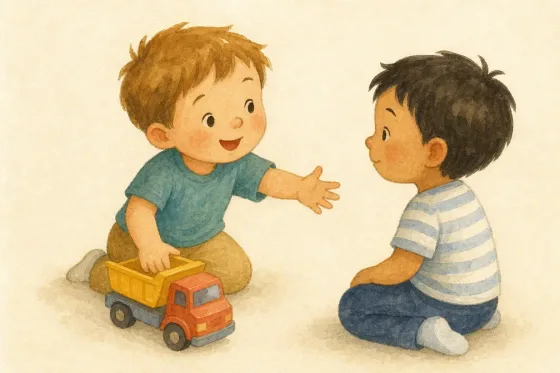
Their First Words can help with your half of the plan: the word in Spanish or Korean, ready before the moment arrives. Each card has the picture, the written word and a female and a male native voice to copy, in whichever of the eight languages you pick on the language pill. The picture at the top of this page is the “Do you want to play?” card, one of the 35 free phrases: ¿Quieres jugar? in Spanish, 같이 놀래? in Korean. It is a prompt for you, not your child’s teacher, and it will not make either of you fluent. The exchange that counts is the one you have together.
In short
Questions parents ask.
Can I teach my child a language I don’t speak?
Partly. You can give a real start, especially if you learn the everyday words alongside your child and use them in daily routines. Making a child fluent on your own is harder; researchers who study early bilingualism note that in some cases, where a family is not fluent in a second language, early bilingualism might be unrealistic. The plan with the best odds adds at least one person or place where the language is spoken natively, such as a caregiver, relatives, a playgroup or a class.
Will my non-native accent confuse my child?
Probably not. In a study of more than 3,000 toddlers in the Toronto area, children who heard a lot of English in a second-language accent had vocabularies similar in size to children who heard mostly the local accent, though they heard the local accent too. In another study, non-native mothers who rated their English as good talked with their two-year-olds about as richly as native speakers; those who rated it limited used fewer different words and shorter sentences. Range is the part that grows as you learn.
How do I teach my toddler Spanish if I don’t speak it?
Small is a good place to begin: a few daily routines, such as snack, bath and getting dressed, with the handful of Spanish words each one needs, learned a week before you use them. Songs and picture books in Spanish add more. At least one person or place in the week where Spanish is spoken natively, such as a babysitter, a playgroup, a library story time or a class, adds what a learning parent cannot. A few real exchanges a day is a fine goal; fluency is not the bar.
What if only one parent speaks the language?
That parent’s time in the language counts for a lot, so the routines, books and songs they share with your child are worth protecting. The other parent does not need to speak it to help: learning a few routine words, joining the songs and making room for calls with relatives all add to it. Other speakers, such as grandparents, a caregiver or a playgroup, bring voices the family alone cannot. Our exposure guide covers a large study of who speaks what at home.
What this is based on
Sources
- Byers-Heinlein, K. & Lew-Williams, C. (2013). Bilingualism in the early years: what the science says. LEARNing Landscapes, 7(1), 95–112. PMC6168212
- Kuhl, P. K., Tsao, F.-M. & Liu, H.-M. (2003). Foreign-language experience in infancy: effects of short-term exposure and social interaction on phonetic learning. PNAS, 100(15), 9096–9101. PMC166444
- AAP and ASHA, Young Children Learning Multiple Languages: Parent FAQs (updated November 2025) — use the language you are most comfortable with; mixing is normal; count the words in every language. healthychildren.org
- Fung, P., Buckler, H. & Johnson, E. K. (2026). Vocabulary growth among children in a linguistically diverse community: a large-scale study. Child Development, 97(5), 1810–1816. doi:10.1093/chidev/aacag063
- Hoff, E., Core, C. & Shanks, K. F. (2020). The quality of child-directed speech depends on the speaker’s language proficiency. Journal of Child Language, 47(1), 132–145. PMC7153570
- Place, S. & Hoff, E. (2011). Properties of dual language exposure that influence 2-year-olds’ bilingual proficiency. Child Development, 82(6), 1834–1849. PMC4144198
- Ferjan Ramírez, N., Sheth, K. K. & Kuhl, P. K. (2021). The effects of age, dosage, and poverty on second language learning through SparkLing™ in infant education centers in Madrid, Spain. International Journal of Environmental Research and Public Health, 18(23), 12758. PMC8656938
- Keller, K., Troesch, L. M. & Grob, A. (2015). A large receptive–expressive gap in bilingual children. Frontiers in Psychology, 6, 1284. PMC4548084
- Giguere, D. & Hoff, E. (2022). Bilingual development in the receptive and expressive domains: they differ. International Journal of Bilingual Education and Bilingualism, 25(10), 3849–3858. PMC9635451
Simple Words, Special Moments
Start with one word.
75 words and 35 phrases are free, forever, with both voices. One $9.99 purchase opens the rest of the 1,000+ words and 500+ phrases, in all eight languages at once. No subscription, nothing renews.
More guides
Keep reading.
 How much exposure does a bilingual toddler need?The floor researchers use, why the home language is the one at risk, and where the extra minutes come from.Read the guide · 8 min ›
 Raising a bilingual toddler: what the research says.Why mixing is normal, how vocabulary grows, and where two languages fit into family life.Read the guide · 7 min ›
 A two-language card routine for an ordinary meal.Milk, banana, spoon and More, please: four cards for an ordinary meal in two languages.Read the guide · 5 min ›
Choosing an app? Our guides to the best first words app for bilingual families and the best Spanish app for toddlers.