Home › Guides › Bilingual toddlers
Two languages, one small child
Raising a bilingual toddler: what the research says.
The two worries every bilingual family hears — confusion and delay — are not supported by the evidence. What the evidence does say is simpler and more useful: each language needs enough input, from people, and you should count words in both.
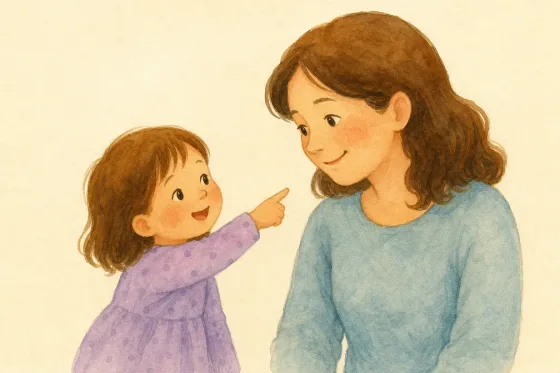
The two worries
“Won’t two languages confuse them?” No. Infants can tell two languages apart from very early on — bilingual newborns already discriminate their two languages, and by the toddler years children keep the two systems separate even while they borrow between them.1 A toddler who says “I want leche” is not confused; mixing words from both languages inside one sentence is an expected part of multilingual communication, including for adults.1
“Won’t it delay their speech?” Also no. Bilingual children babble, say first words and combine words on a similar timetable to monolingual children.1, 2 Nationwide Children’s Hospital puts it plainly for parents: learning two languages in childhood does not cause confusion or language delay.3
The one thing that looks like delay but is not: a bilingual toddler’s words are spread across two languages. Counting only English can underestimate what a child knows. Assessment should consider every language and the child’s exposure, understanding and communication; a combined word count is not an all-clear.2, 8
What the evidence says
Input is split, so each language gets less of it
The clearest finding in the literature is almost arithmetic. Exposure is related to growth in each language: in a large study of toddlers exposed to Spanish and English, each language’s vocabulary tracked the share of exposure that language received.2 A child who hears 70% English and 30% Spanish will, for a while, know more English words — and that is not a problem to fix, it is a description of the input. If you want the home language to keep up, it needs hours, not intentions.
The input has to come from people
In the study every bilingual parent should know, nine-month-old American infants who spent a few short sessions with a live Mandarin speaker learned to hear Mandarin sound contrasts. A matched group given the identical material on video or audio only did not show the same learning on that test.4 This measured a particular speech-sound contrast, not every kind of language learning. Video calls can connect family members, but the WHO guideline does not specify a video-chat exception. See our screen-time guide for current guidance.5, 6
More than one speaker helps
Fourteen-month-olds who heard new words from several different talkers learned to tell those words apart; the ones who heard the same words from a single talker did not.7 That result came from a controlled word-learning task; it does not prove a benefit from an app’s two recordings. For a heritage language this is an argument for the grandmother, the uncle, the babysitter, the friend from the same country — anyone who will say the words to the child.
You do not have to be a native speaker, or split by person
“One parent, one language” is one workable strategy, not a rule; families succeed with one language at home and another outside, or with both from both parents.1 What matters is enough rich input in each language, and a reason for the child to use it. Use the languages you are most comfortable speaking, and include relatives or other speakers when you can.8
What to do, practically
- Protect the minority language. The community language will take care of itself at daycare and school. The home language is the one that needs deliberate hours: meals, bath, bedtime, and every call with family.
- Count both languages. Count words in both languages and share the list with the evaluator. That total is for the evaluator to interpret, not a pass mark.
- Let mixing happen. Respond to the meaning, in whichever language you were speaking. You can model the full sentence back without correcting.
- Give the child people, not media. Relatives, playdates, community groups, Saturday school. A recording can model pronunciation; it does not replace back-and-forth interaction.
- Keep it warm. Make room for conversation and play rather than insisting on a correct reply. The goal for a toddler is not fluency; it is enough words to hold up their end of a call to grandma.
When to ask for help
Ask about any missed milestone or communication concern; do not wait for there to be no words. Contact your child’s doctor promptly if words or other skills are lost. An assessment should consider all the child’s languages, with an interpreter if needed.8, 9 The first words guide explains the next steps.
Where an app fits, honestly
Not as a teacher. What a flashcard app can do for a bilingual family is hand the parent the word in the language they are less sure of — one picture, the word written the way the language writes it, and a native voice to copy — so that the parent says it to the child. Two native voices per language are a listening option; the study above does not establish their effectiveness. If you use ours, the eight languages sit on the same card, so the same picture can be leche and then milk, one tap apart.
What this is based on
Sources
- Byers-Heinlein, K. & Lew-Williams, C. (2013). Bilingualism in the early years: what the science says. LEARNing Landscapes, 7(1), 95–112. PMC6168212
- Hoff, E., Core, C., Place, S., Rumiche, R., Señor, M. & Parra, M. (2012). Dual language exposure and early bilingual development. Journal of Child Language, 39(1), 1–27. doi:10.1017/S0305000910000759
- Nationwide Children’s Hospital (2017). Teaching kids a second language: can it cause a speech delay? nationwidechildrens.org
- Kuhl, P. K., Tsao, F.-M. & Liu, H.-M. (2003). Foreign-language experience in infancy: effects of short-term exposure and social interaction on phonetic learning. PNAS, 100(15), 9096–9101. pnas.org
- World Health Organization (2019). Guidelines on physical activity, sedentary behaviour and sleep for children under 5 years of age. who.int
- American Academy of Pediatrics, Media and children — family media guidance. aap.org
- Rost, G. C. & McMurray, B. (2009). Speaker variability augments phonological processing in early word learning. Developmental Science, 12(2), 339–349. doi:10.1111/j.1467-7687.2008.00786.x
- AAP and ASHA, Young Children Learning Multiple Languages: Parent FAQs: language exposure, assessment and support. healthychildren.org
- CDC, Concerned About Your Child’s Development?: missed milestones, screening and evaluation. cdc.gov
More guides
Keep reading.
 When do babies say their first words?Around the first birthday for many children. What to notice and when to ask.Read the guide · 6 min ›
 How to use flashcards with a toddler (without turning it into a quiz).Five suggestions for sharing cards without a quiz.Read the guide · 5 min ›
 Is my toddler a late talker? When to ask for help.Word counts can raise a concern; they cannot tell you whether your child needs support. Here is who to ask.Read the guide · 5 min ›
 Does a second language delay a child’s speech?No — and here are the studies to hand to whoever asked.Read the guide · 6 min ›
 How many words should an 18-month-old say?What the 18-month checklist can tell you, what it cannot, and when to ask.Read the guide · 3 min ›
 Screen time under two: what the research actually says.Current guidance, limits of the research, and how it applies to our app.Read the guide · 3 min ›
 A first words list by age.The categories that often come first across languages, and roughly when, from 12 months to 3.Read the guide · 7 min ›
 From a mealtime word to a useful phrase.Use four real cards, playable audio, and one printable sheet during a meal.Read the guide · 4 min ›
- A two-language card routine for an ordinary meal.A small English–Spanish meal routine with actual cards and recordings.Read the guide · 5 min ›
 First Spanish words for toddlers: 75 to start with.Seventy-five words by age and topic, each with a native voice to copy — and which five to start with.Read the guide · 6 min ›
 One little picnic: name it, count it, sort it.Four Spanish cards to hear and print, a count, a sort, and one short film — for one ordinary outing.Read the guide · 6 min ›
Simple Words, Special Moments
Start with one word.
75 words and 35 phrases are free, forever, with both voices. One $9.99 purchase opens the rest of the 1,000+ words and 500+ phrases, in all eight languages at once. No subscription, nothing renews.