Home › Guides › The bilingual delay myth
The question every bilingual parent gets asked
Does a second language delay a child’s speech?
It is one of the most common questions bilingual parents hear, usually from someone who loves the child. The research answer is a clear no — with three things worth knowing about how bilingual vocabularies grow, and one about how to count them.
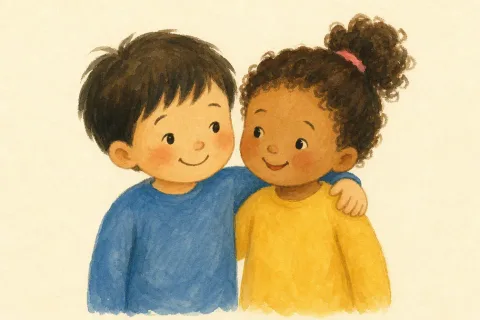
Bilingualism is not a cause of language disorder
Babies raised with two languages from birth babble at the same age, say their first words at about the same age, and start combining words at about the same age as babies raised with one.1 A study that followed bilingual infants — including children learning a signed and a spoken language at once — found first words and first two-word combinations landing in the same windows as the monolingual norms, in both languages.1 Two languages do not take turns in a child’s head; they grow side by side.
The short version: bilingualism does not cause language delay. A bilingual child can still have a language difficulty and deserves an assessment that considers every language.8
Where the myth comes from
Count a bilingual two-year-old’s words in only one of their languages and you will often get a smaller number than a monolingual child’s. That is real, and it is the whole basis of the worry. But a child who hears Spanish at home and English at daycare knows leche and milk, zapato and shoe — and also words that exist only in one setting: the daycare’s circle time, the grandmother’s abuelita. Those are different measures: total vocabulary adds word forms across languages; conceptual vocabulary counts a shared meaning once. In one study of Spanish–English toddlers aged 22 to 30 months, total vocabulary was comparable to the monolingual group; conceptual vocabulary was smaller.3 Neither calculation alone can rule out a language difficulty.
Three things that are true about bilingual vocabularies
1. Input is split, so each language grows with its share
A child who hears a language 30% of the time will, for a while, know fewer words in it than a child who hears it 100% of the time. The size of a bilingual toddler’s vocabulary in each language tracks how much of that language they hear.2, 4 Exposure matters, but it does not produce a fixed word total or explain away every concern.
2. Mixing is a skill, not confusion
Bilingual toddlers put words from both languages in one sentence — “more leche”, “quiero ball”. This is code-mixing, bilingual adults do it too, and children do it according to the grammar of the languages involved and according to who they are talking to.5 A two-year-old who says “agua please” to a grandparent and “water please” at daycare is not muddled. They are choosing.
3. A delay, when there is one, is not caused by the second language
Children with genuine language disorders can and do become bilingual, and there is no evidence that dropping a language helps them; the professional guidance is to support both.6 If a bilingual child needs speech therapy, the therapy should account for both languages — and the family’s home language should stay.
What to tell the doctor
If a pediatrician or a relative suggests dropping a language to “help” a late-talking toddler, three sentences cover it:
- Bilingualism does not cause a language disorder; children still vary in their development.8
- Vocabulary should be counted across both languages; that is the standard in the research.3
- If there is a real delay, the guidance from speech-language professionals is to evaluate in both languages and keep both.6
Then keep the word list. Write down spoken words and meaningful sound approximations in each language, and record signs and gestures separately. Give the evaluator examples and explain how much your child uses each language. The late-talker guide explains what word counts can and cannot tell you, the signs worth a call, and how to ask for an assessment.
What helps a bilingual toddler
The same things that help any toddler, in each language: a real person, naming what the child is looking at, in the moment.7 If the minority language is the one that gets fewer minutes, give it the routines — bath, bedtime, breakfast — so there are regular chances to talk together. If you use our cards, the useful trick is the language switch on the card: the same picture can be milk at breakfast and leche at dinner, as an example you can talk about together. The bilingual toddler guide goes through the research on how, household by household.
What this is based on
Sources
- Petitto, L. A., Katerelos, M., Levy, B. G., Gauna, K., Tétreault, K. & Ferraro, V. (2001). Bilingual signed and spoken language acquisition from birth: implications for the mechanisms underlying early bilingual language acquisition. Journal of Child Language, 28(2), 453–496. doi:10.1017/S0305000901004718
- Hoff, E., Core, C., Place, S., Rumiche, R., Señor, M. & Parra, M. (2012). Dual language exposure and early bilingual development. Journal of Child Language, 39(1), 1–27. doi:10.1017/S0305000910000759
- Core, C., Hoff, E., Rumiche, R. & Señor, M. (2013). Total and conceptual vocabulary in Spanish–English bilinguals from 22 to 30 months: implications for assessment. Journal of Speech, Language, and Hearing Research, 56(5), 1637–1649. doi:10.1044/1092-4388(2013/11-0044)
- Pearson, B. Z., Fernández, S. C., Lewedeg, V. & Oller, D. K. (1997). The relation of input factors to lexical learning by bilingual infants. Applied Psycholinguistics, 18(1), 41–58. doi:10.1017/S0142716400009863
- Byers-Heinlein, K. & Lew-Williams, C. (2013). Bilingualism in the early years: what the science says. LEARNing Landscapes, 7(1), 95–112. PMC6168212
- American Speech-Language-Hearing Association, Bilingual Service Delivery (Practice Portal): assessment and intervention in both languages. asha.org
- Kuhl, P. K., Tsao, F.-M. & Liu, H.-M. (2003). Foreign-language experience in infancy: effects of short-term exposure and social interaction on phonetic learning. PNAS, 100(15), 9096–9101. pnas.org
- AAP and ASHA, Young Children Learning Multiple Languages: Parent FAQs: language exposure, assessment and support. healthychildren.org
More guides
Keep reading.
 When do babies say their first words?Around the first birthday for many children. What to notice and when to ask.Read the guide · 6 min ›
 Raising a bilingual toddler: what the research says.What the research says about two languages at home, and how to make it work.Read the guide · 7 min ›
 How to use flashcards with a toddler (without turning it into a quiz).Five suggestions for sharing cards without a quiz.Read the guide · 5 min ›
 Is my toddler a late talker? When to ask for help.Word counts can raise a concern; they cannot tell you whether your child needs support. Here is who to ask.Read the guide · 5 min ›
 How many words should an 18-month-old say?What the 18-month checklist can tell you, what it cannot, and when to ask.Read the guide · 3 min ›
 Screen time under two: what the research actually says.Current guidance, limits of the research, and how it applies to our app.Read the guide · 3 min ›
 A first words list by age.The categories that often come first across languages, and roughly when, from 12 months to 3.Read the guide · 7 min ›
 From a mealtime word to a useful phrase.Use four real cards, playable audio, and one printable sheet during a meal.Read the guide · 4 min ›
- A two-language card routine for an ordinary meal.A small English–Spanish meal routine with actual cards and recordings.Read the guide · 5 min ›
 First Spanish words for toddlers: 75 to start with.Seventy-five words by age and topic, each with a native voice to copy — and which five to start with.Read the guide · 6 min ›
 One little picnic: name it, count it, sort it.Four Spanish cards to hear and print, a count, a sort, and one short film — for one ordinary outing.Read the guide · 6 min ›
Simple Words, Special Moments
Start with one word.
75 words and 35 phrases are free, forever, with both voices. One $9.99 purchase opens the rest of the 1,000+ words and 500+ phrases, in all eight languages at once. No subscription, nothing renews.