Home › Guides › Answers in English
When the home language goes quiet
My child understands our language but answers in English.
You speak Spanish, or Korean, or Russian, and your child understands every word. Then they answer in English. This is one of the most common turns in a bilingual family. Here is why it happens, why speaking still matters, and what tends to help.
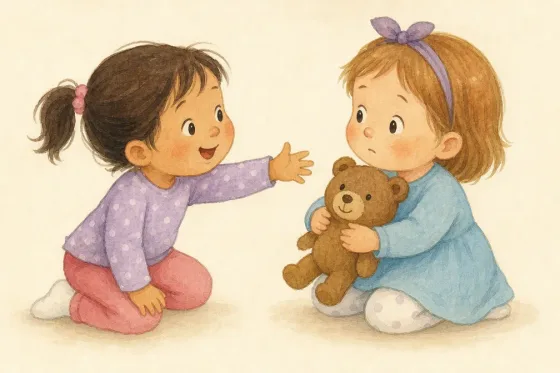
The short answer
This is very common. Researchers describe it almost as a rule of thumb: “parents tend to use the minority language,” while “children tend to use the majority language.”1 In a survey of 1,899 families, every child spoke the majority language, while speaking the minority language was not universal.2 Your child understanding you is a real achievement, and on its own, answering in English is not a sign of a delay.3
It is still worth a gentle response, because understanding a language and speaking it grow somewhat separately. English here stands in for whichever language surrounds your family.
Why it happens
Your child has noticed that English works everywhere, and that you understand it. Bilingual children learn to choose the language suited to the person in front of them.3 Answering you in English is usually that same skill at work.
Life around them pushes the same way. In a study of Spanish–English homes, children showed stronger growth in English than in Spanish between 30 and 60 months, and the authors noted that early exposure to Spanish at home does not guarantee a child will acquire it.4 Older siblings add to the tide. In two studies of toddlers in bilingual homes, older siblings used English with them more than other household members did. A school-aged sibling also increased mothers’ use of English, and toddlers without one were more advanced in Spanish.5
Why speaking still matters
Hearing a language builds understanding. Using it seems to build speaking in its own right. One study followed 47 Spanish–English children from 30 to 42 months, whose choices about which language to speak meant that what they said did not match what they heard. Their speaking was linked to growth in their expressive vocabulary, but not to growth in what they understood.6 That study measured English, and it suggests the same logic for any language: a child gets better at saying things by saying them.
The practical version. Your talking keeps the language understood. Their talking, even a word at a time, is what builds speaking. The aim is small, friendly reasons to use it, not more pressure.
What tends to help
- Staying in your language. Replying in it, even to an English answer, keeps it in the conversation. Understanding comes first, and your replies are what it is built from.
- Handing back the phrase. If your child says “I want water,” you can answer with the whole thing in your language as you pour it. ASHA’s advice is to repeat what your child says and add to it.7 They do not need to say it back.
- A soft “what did you say?” In one study, two- and three-year-olds played with an adult who used only one language. When the children used the other language, they could switch to match, even after a plain “What?”8 That was a game with a researcher, so it shows that children can do this, not that it should happen every time. The odd one, said warmly, is plenty.
- People who need the language. A grandparent on a video call, a caregiver or a playgroup gives your child a real reason to use it, because English will not work there. The number of different speakers a child hears can matter too.9
- Places where the language lives. Bedtime songs, a favorite book or the same words at breakfast give it a regular home.
We would not make it a test. A tired three-year-old waiting on the right words is having a hard moment, not a language lesson. Some weeks they will answer in English all week, and you can still answer in yours.
When to ask
Answering in English on its own is not a reason to worry. The AAP and ASHA say a speech or language problem shows up in all the languages a child uses, so the question is about your child’s talking as a whole.3 It is worth talking with your child’s doctor if your child has few words across their languages, has trouble understanding, or has lost skills.10 An assessment should look at every language your child uses.3 Our late-talker guide walks through what happens next, and our guide to bilingual children and speech delay covers why two languages are not the cause.
Having the words ready
Your own home language may have gaps for toddler talk, especially if you grew up speaking it only at home. Their First Words has 500+ everyday phrases in nine themes and 1,000+ words, in eight languages, with a female and a male native voice on every card. 75 words and 35 phrases are free. It gives you the phrase when you are reaching for it, and the conversation stays yours. If your family is planning who speaks what, our guide to one parent, one language is a good next read.
In short
Questions parents ask.
Why does my child understand Spanish but answer in English?
Children tend to use the language that works most widely around them, and they know you understand English. Researchers describe this pattern often: parents use the minority language while children use the majority one. School, daycare and older siblings all add to it.
Is answering in English a sign of a speech delay?
Not on its own. The AAP and ASHA say a speech or language problem shows up in all the languages a child uses. A child who talks well in English and understands your language is a different picture from one who is having trouble in both.
Should I insist that my child answers in our language?
A light touch tends to work better than a rule. Replying in your language, offering the phrase they were reaching for and asking the odd “what did you say?” keep the language in play without turning a chat into a test.
Will my child lose the home language?
It can fade, and early exposure alone does not guarantee a child will speak it. A child who understands it well still has a great deal to build on, and regular time with people who speak it gives them reasons to use it.
What this is based on
Sources
- Tare, M. & Gelman, S. A. (2011). Bilingual parents’ modeling of pragmatic language use in multiparty interactions. Applied Psycholinguistics, 32(4), 761–780. PMC3786164
- De Houwer, A. (2007). Parental language input patterns and children’s bilingual use. Applied Psycholinguistics, 28(3), 411–424. doi:10.1017/S0142716407070221
- AAP and ASHA, Young Children Learning Multiple Languages: Parent FAQs (updated November 2025) — children use the language most appropriate for the person they are talking to; a speech or language problem shows up in all languages a child uses; assessment considers every language. healthychildren.org
- Hoff, E. & Ribot, K. M. (2017). Language growth in English monolingual and Spanish-English bilingual children from 2.5 to 5 years. The Journal of Pediatrics, 190, 241–245. PMC5690817
- Bridges, K. & Hoff, E. (2014). Older sibling influences on the language environment and language development of toddlers in bilingual homes. Applied Psycholinguistics, 35(2), 225–241. PMC4208071
- Ribot, K. M., Hoff, E. & Burridge, A. (2018). Language use contributes to expressive language growth: evidence from bilingual children. Child Development, 89(3), 929–940. PMC5573667
- American Speech-Language-Hearing Association, Communication Milestones: 2 to 3 Years: “Repeat what your child says and add to it.” asha.org
- Comeau, L., Genesee, F. & Mendelson, M. (2007). Bilingual children’s repairs of breakdowns in communication. Journal of Child Language, 34(1), 159–174. doi:10.1017/S0305000906007690
- Place, S. & Hoff, E. (2011). Properties of dual language exposure that influence 2-year-olds’ bilingual proficiency. Child Development, 82(6), 1834–1849. doi:10.1111/j.1467-8624.2011.01660.x
- CDC, Concerned About Your Child’s Development? (reviewed February 17, 2026) — missed milestones, screening and evaluation. cdc.gov
Simple Words, Special Moments
Start with one word.
75 words and 35 phrases are free, forever, with both voices. One $9.99 purchase opens the rest of the 1,000+ words and 500+ phrases, in all eight languages at once. No subscription, nothing renews.
More guides
Keep reading.
 One parent, one language: does it work?What two large family surveys found, and what matters more than the rule.Read the guide · 5 min ›
 How much exposure does a bilingual toddler need?The floor researchers use, why the home language is the one at risk, and where the extra minutes come from.Read the guide · 8 min ›
 Does a second language delay a child’s speech?Why two languages do not cause delay, and how to describe what your child knows.Read the guide · 6 min ›
Choosing an app? Our guides to the best apps for bilingual families and the best Spanish app for toddlers.