Home › Guides › One parent, one language
Who speaks what at home
One parent, one language: does it work?
One parent speaks one language, the other parent speaks the other, and nobody switches. It is the best-known rule in bilingual parenting, and it can work. It is also neither required nor a guarantee. Here is what the research found, and what seems to matter more.
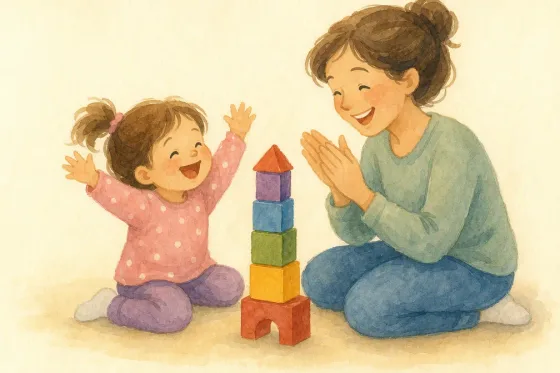
The short answer
It can work, and it is not the deciding factor. In a survey of 1,899 families, one parent, one language was neither necessary nor sufficient for a child to speak the minority language.1 Families succeed with it, and families succeed without it. What seems to matter more is how much of the language your child hears, from how many people, and whether it has a real place in daily life.2, 3
What 1,899 families showed
Researcher Annick De Houwer asked why some children exposed to two languages from early on do not end up speaking both. She collected questionnaires from 1,899 families in which at least one parent spoke a language other than the majority language, each with a child aged six to ten.1
Every child spoke the majority language. Speaking the minority language was not universal, and it tracked what parents did at home. Homes where both parents used the minority language, and at most one parent spoke the majority language, had a high chance of success. One parent, one language did not provide a necessary or a sufficient condition.1
Put simply, the majority language tends to look after itself. The home language is the one that needs the hours.
A newer look
A 2025 survey of 280 families in Australia asked parents how they use language at home and how well they felt the heritage language was being passed on. Families using one parent, one language reported significantly more success than families with mixed use or a single caregiver using the language, and so did families where both caregivers used only the heritage language. Mixed-language families with high use of the heritage language felt about as successful as those two groups.4
The authors concluded that language input is probably central but not the only factor. Families reporting more success showed strong commitment to the language, with caregivers likely backing each other up.4 Both surveys rest on what parents reported, and they are looking at different things, so neither is a verdict on any one family.
The practical version. A rule is useful if it protects time in the quieter language. The hours do the work, and the rule is one way of keeping them.
Why the hours matter more
Researchers generally consider a child bilingual when each language makes up at least ten to twenty-five percent of what they hear, and they add that this does not guarantee a child will use both.2 Above that floor, more exposure tends to mean more words.3 One parent, one language says nothing about the clock. If the parent with the home language is out of the house for most of the waking day, the rule can be followed perfectly and still leave little time in that language.
Who is talking matters as well. In a study of 29 Spanish–English two-year-olds, the relative amount of each language predicted how well it was coming along, and for English, so did the number of different people a child heard it from.5 Our guide to how much exposure a bilingual toddler needs goes through this in more detail.
Slipping between languages is normal
You do not need to police yourself. The AAP and ASHA advise using the languages you are most comfortable with, and they describe mixing as a normal part of growing up with more than one.6 When researchers recorded bilingual caregivers playing with their toddlers, every one of them switched languages at least once.7 A parent who says the odd word in the other language has not broken anything. Our guide to bilingual two-year-olds has more on mixing.
Different homes, different plans
- Both parents speak the home language. Home language at home, with English from school and the wider world, is the pattern with the best odds.1
- One parent speaks it. One parent, one language is a natural fit. That parent’s minutes carry more weight, so grandparents, caregivers and playgroups can help a lot.5
- Neither parent speaks it fluently. A rule is less useful than regular time with people who do. Our guide to teaching a language you do not speak covers this.
- An older sibling is at school. Older siblings often bring English home. In two studies, they used English with toddlers more than other household members did, and a school-aged sibling increased mothers’ use of English too.8
Whatever the plan, children often start answering in English at some point. Our guide to a child who understands but answers in English looks at that next step.
Where Their First Words fits
Their First Words puts each card in eight languages, with a female and a male native voice, so each of you can use the same picture in the language you speak. 75 words and 35 phrases are free in every language. It gives you the word or phrase when you are reaching for it. It counts as a prompt, not as exposure; the minutes that matter are the ones you and your child spend talking.
In short
Questions parents ask.
Does one parent, one language work?
It can, and it is not the only way. In a survey of 1,899 families, the approach was neither necessary nor sufficient for a child to speak the minority language. A 2025 survey of 280 families found it did well, alongside families where both parents used the home language.
Is it bad to mix languages with my child?
No. The AAP and ASHA advise using the languages you are most comfortable with, and most bilingual parents mix at times. In the research, how much a child hears a language tends to matter more than keeping the two strictly apart.
What if my partner does not speak the home language?
That is the classic case for one parent, one language, and it can work. That parent’s time with your child then carries most of the language, so other speakers such as grandparents, caregivers and playgroups can add a great deal.
Should both parents speak the minority language at home?
If both of you can, it is the pattern with the best odds. In the 1,899-family survey, homes where both parents used the minority language and at most one used the majority language had a high chance of success.
What this is based on
Sources
- De Houwer, A. (2007). Parental language input patterns and children’s bilingual use. Applied Psycholinguistics, 28(3), 411–424. doi:10.1017/S0142716407070221
- Byers-Heinlein, K. & Lew-Williams, C. (2013). Bilingualism in the early years: what the science says. LEARNing Landscapes, 7(1), 95–112. PMC6168212
- Hoff, E., Core, C., Place, S., Rumiche, R., Señor, M. & Parra, M. (2012). Dual language exposure and early bilingual development. Journal of Child Language, 39(1), 1–27. doi:10.1017/S0305000910000759
- Pino Escobar, G., Diskin-Holdaway, C. & Escudero, P. (2025). How effective are the different family policies for heritage language maintenance and transmission in Australia? Languages, 10(12), 290. doi:10.3390/languages10120290
- Place, S. & Hoff, E. (2011). Properties of dual language exposure that influence 2-year-olds’ bilingual proficiency. Child Development, 82(6), 1834–1849. doi:10.1111/j.1467-8624.2011.01660.x
- AAP and ASHA, Young Children Learning Multiple Languages: Parent FAQs (updated November 2025) — use the languages you are most comfortable with; mixing is normal. healthychildren.org
- Bail, A., Morini, G. & Newman, R. S. (2015). Look at the gato! Code-switching in speech to toddlers. Journal of Child Language, 42(5), 1073–1101. doi:10.1017/S0305000914000695
- Bridges, K. & Hoff, E. (2014). Older sibling influences on the language environment and language development of toddlers in bilingual homes. Applied Psycholinguistics, 35(2), 225–241. PMC4208071
Simple Words, Special Moments
Start with one word.
75 words and 35 phrases are free, forever, with both voices. One $9.99 purchase opens the rest of the 1,000+ words and 500+ phrases, in all eight languages at once. No subscription, nothing renews.
More guides
Keep reading.
 How much exposure does a bilingual toddler need?The floor researchers use, why the home language is the one at risk, and where the extra minutes come from.Read the guide · 8 min ›
 My child understands our language but answers in English.Why children answer in the majority language, why it still matters, and what helps.Read the guide · 6 min ›
 Can a 2-year-old be bilingual? And is mixing languages normal?Why two is not too late, why "más juice" is a good sign, and how to count a bilingual toddler’s words.Read the guide · 7 min ›
Choosing an app? Our guides to the best apps for bilingual families and the best English app for toddlers with another home language.