Signs, words, or both
Does baby sign language delay talking?
You may have heard that signing with a baby brings words sooner, or that it holds them back. The research supports neither claim very well. Here is what the studies found, what they did show, and how signs and words sit together.
The short answer
As far as the research can tell, no, and it does not seem to speed talking up either. A systematic review published in 2014 sifted through 1,902 citations and found 10 studies that met its criteria. It concluded that the effect of baby sign on communication development remains unclear, and that nothing suggested it interferes with typical development.1 An earlier review of 17 reports found that the evidence did not support claims that signing advances language, and pointed to weaknesses in the studies themselves.2
So both popular claims run ahead of the evidence. Signing looks unlikely to hold speech back, and it is unproven as a shortcut to it. Both reviews looked at hearing babies, and the 2014 review was limited to those with hearing parents.1, 2
The randomized trial
One 2013 study followed 40 babies from 8 to 20 months, and its authors describe it as the first randomized controlled trial of encouraging baby sign. Half of the mothers were trained to model a set of gestures, and the babies’ language was measured often. The babies exposed to gesture did not differ from the others on language outcomes.3
Something else did change. Mothers in the gesture groups were more responsive to their babies’ nonverbal cues, and they encouraged more independent action.3 Forty families is a small study, but it is a useful way to think about signing: it may change how closely you watch your baby, whether or not it changes when words arrive.
The practical version. Sign with your baby because you enjoy it, or because it eases a few daily moments. It is fine to skip it, too. Neither choice appears to change when words arrive.
Why gestures still matter
Taught signs are one thing. The gestures children come up with on their own, such as pointing, showing and waving, are another, and those have a much clearer link to language. In a study of ten children moving from single words to two, many of the words each child first expressed in gesture later moved into their speech. The children who first paired a gesture with a word to make two ideas, pointing at a bird and saying “nap,” were also the first to say two-word combinations such as “bird nap.”4
A later article by one of those researchers describes a child who points at dogs before knowing the word as likely to learn “dog” within three months, and reports that gesture at 18 months predicts vocabulary size at 42 months.5 These are links, seen in children’s own gesturing, so they do not show that teaching signs would have the same effect. They do show that a point is worth answering. “Dog! Big dog.” gives your child the word at the moment they are asking about it.
Signs or words: there is no need to choose
Signs and words go together easily. If you enjoy it, these are a simple way to start:
- A handful from your own day. More, all done, milk and help come up at every meal.
- The word every time. Saying “more” as you sign it keeps the spoken word in the picture.
- An answer to their gestures too. A wave, a reach or a point can get a word back, whether or not it is a sign.
- No materials needed. Ms. Rachel’s videos model signs if you would like to see some.
If your child is not talking yet
The research above is about babies developing typically. For a toddler with few words, signing can be a bridge, and it does not replace asking. Signs are one form of what speech-language pathologists call augmentative and alternative communication. ASHA says the fear that such tools reduce motivation to speak is a misconception, and that their use may help improve natural speech.6 A speech-language pathologist can tell you whether it suits your child.
Talk with your child’s doctor if your child is not meeting milestones, has few gestures, or loses skills; hearing is worth checking too.7, 8 Our guide to words at 18 months has the checklist, and our late-talker guide explains the next steps.
Everything on this page is about hearing babies. For a child who is deaf or hard of hearing, the question is a different one: American Sign Language is a complete, natural language, not a stepping stone to speech.9
Where Their First Words fits
Their First Words does not teach signs. It gives you the word: one picture, one word, and a female and a male native voice to copy, in eight languages. 75 words and 35 phrases are free. It is a prompt for you; the word that counts is the one you say.
In short
Questions parents ask.
Does baby sign language delay speech?
The research has found no evidence that it does. A systematic review of studies with typically developing hearing babies found nothing to suggest baby sign interferes with typical development.
Does baby sign language help babies talk sooner?
There is little good evidence for that. Two reviews found the benefits unclear or unsupported, and in the first randomized trial, babies whose mothers modeled gestures did no better on language measures than other babies.
When can you start baby sign?
No best age has been tested. The first randomized trial followed babies from 8 months to 20 months, so that is one point of reference.
Do signs count as first words?
Signs are real communication, and it is worth noting them. When you talk with your child’s doctor about a spoken-word milestone, keeping signs as a separate note beside the spoken words gives the clearest picture.
What this is based on
Sources
- Fitzpatrick, E. M., Thibert, J., Grandpierre, V. & Johnston, J. C. (2014). How HANDy are baby signs? A systematic review of the impact of gestural communication on typically developing, hearing infants under the age of 36 months. First Language, 34(6), 486–509. doi:10.1177/0142723714562864
- Johnston, J. C., Durieux-Smith, A. & Bloom, K. (2005). Teaching gestural signs to infants to advance child development: a review of the evidence. First Language, 25(2), 235–251. doi:10.1177/0142723705050340
- Kirk, E., Howlett, N., Pine, K. J. & Fletcher, B. C. (2013). To sign or not to sign? The impact of encouraging infants to gesture on infant language and maternal mind-mindedness. Child Development, 84(2), 574–590. doi:10.1111/j.1467-8624.2012.01874.x
- Iverson, J. M. & Goldin-Meadow, S. (2005). Gesture paves the way for language development. Psychological Science, 16(5), 367–371. doi:10.1111/j.0956-7976.2005.01542.x
- Goldin-Meadow, S. (2015). Gesture as a window onto communicative abilities: implications for diagnosis and intervention. Perspectives on Language Learning and Education, 22(2), 50–60. PMC4564136
- American Speech-Language-Hearing Association, Augmentative and Alternative Communication (Practice Portal): manual signs are an unaided form of AAC; the belief that AAC reduces motivation to speak is treated as a misconception; AAC “may help improve natural speech.” asha.org
- CDC, Concerned About Your Child’s Development? (reviewed February 17, 2026) — talk with the doctor, ask about screening, and a free early-intervention evaluation without a referral. cdc.gov
- National Institute on Deafness and Other Communication Disorders, Speech and Language Developmental Milestones: a hearing test is often part of the evaluation. nidcd.nih.gov
- National Institute on Deafness and Other Communication Disorders, American Sign Language: “American Sign Language (ASL) is a complete, natural language.” nidcd.nih.gov
Simple Words, Special Moments
Start with one word.
75 words and 35 phrases are free, forever, with both voices. One $9.99 purchase opens the rest of the 1,000+ words and 500+ phrases, in all eight languages at once. No subscription, nothing renews.
More guides
Keep reading.
 When do babies say their first words?Around the first birthday for many children. What to notice and when to ask.Read the guide · 6 min ›
 How many words should an 18-month-old say?What the 18-month checklist can tell you, what it cannot, and when to ask.Read the guide · 3 min ›
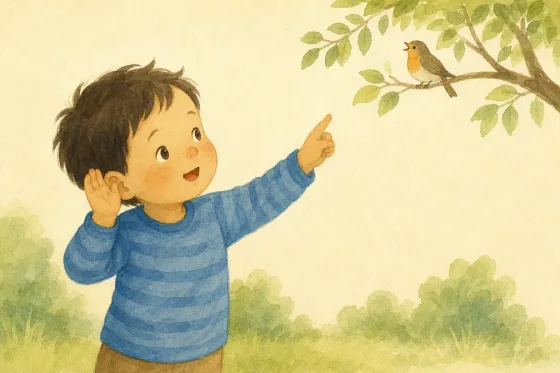 How to help your toddler talk: what the research supports.Turns, parentese, one word more and a pause, with a breakfast example for each.Read the guide · 7 min ›
Choosing an app? Our guides to the best first words app for babies and the best learning apps for 1-year-olds.