Home › Guides › Helping toddlers talk
Conversation, not drills
How to help your toddler talk: what the research supports.
Helping a toddler talk does not take a program, a special toy or a quiz. The research keeps pointing to ordinary moments: a back-and-forth turn, a word for what your toddler is looking at, one word added to theirs, and a pause long enough for a reply. Here is the evidence for each, and what it looks like at breakfast.
The short answer: conversation
Many parents have heard that the goal is more words. The research is more specific. In a study of thirty-six children aged four to six, more back-and-forth conversational turns at home went with stronger activity in a language area of the brain, even after accounting for how many words the adults said, and with stronger verbal skills.1 In another, which recorded 146 babies and toddlers at home for a day each month over six months, turns at 18 to 24 months were linked with vocabulary and verbal comprehension scores about ten years later.2 Both studies show links, not proof that the turns caused the gains.1, 2
A trial put this to the test. Seventy-nine families of typically developing six-month-olds were randomly assigned to coaching sessions or none, and the seventy-one in the final analysis were followed to eighteen months. Coached parents used more parentese and more back-and-forth turns, and their children had larger vocabularies at eighteen months on a parent-report checklist.3
Your child’s turn does not have to be a word. A sound, a look or a point can be the next move in the conversation. Breakfast has plenty of chances, and one or two is a fine morning.
What helps, at breakfast
1. A back-and-forth turn
The turn is what the studies above counted: a sound from your child, a reply from you, then perhaps another from them.1, 2, 3
At breakfast: your toddler bangs the spoon and says “ba!” You say “Bang! Bang, bang.” They bang again. That is a conversation.
2. Parentese
Parentese is the higher-pitched, slower, sing-song way most adults already talk to babies, and it uses real words in real sentences.3 In a study that recorded twenty-six babies at home at eleven or fourteen months, parentese spoken one-on-one was linked with how much the babies vocalized at the time and how many words they said at two.4
At breakfast: “Do you want some toooast? Warm toast?” A little slower, a little higher, with your face close to theirs.
3. A word for what they are already looking at
In a classic study of twenty-four children filmed with their mothers at fifteen and twenty-one months, words about whatever the child was already looking at went with larger vocabularies at twenty-one months; words that tried to pull the child’s attention elsewhere went with smaller ones. In a second experiment, ten 17-month-olds learned new words better when the word named the thing they were already focused on.5
At breakfast: they are staring at the steam from your mug, not the toast you are holding up. “Hot. My tea is hot.” The toast can wait.
4. One word more
The CDC’s tip at eighteen months is to add to the words your child says: if they say “Dog,” you might answer “Yes, that’s a dog. Dogs say ‘woof, woof.’”6 The same move gives an unclear word back clearly; the CDC’s example at two is “or nana,” answered with “You want more banana.”7 Imitating or expanding a child’s words is on ASHA’s list of interaction styles that encourage language, a list speech-language pathologists share with parents.8 For children with language difficulties, coaching parents in language strategies helps: a review of eighteen studies of children aged 18 months to five found positive effects on both understanding and talking.9
At breakfast: “Berry.” “Blueberry! A little blueberry.” No “Can you say blueberry?” needed.
5. A pause
A turn needs a gap to happen in. ASHA’s list of interaction styles that encourage language includes giving a child adequate time to start communicating and to respond.8 A few seconds of quiet, with an interested face, leaves room for one.
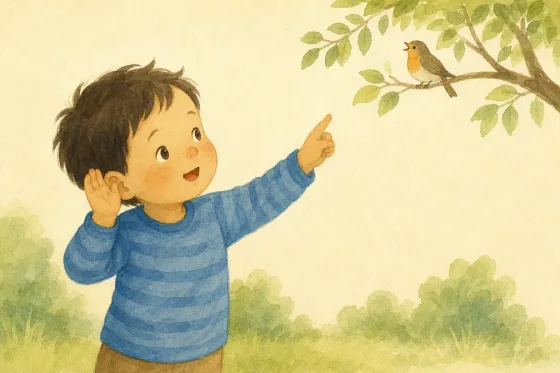
At breakfast: the kettle starts to whistle. “Do you hear that?” Then a few seconds of quiet. A look toward the stove, a sound or a word is their turn.
6. An answer to a point
Children often use gestures to communicate before they use words. In a study that followed ten children from single words to two-word combinations, many words showed up first as gestures and later in speech, and the children who first paired a point with a word — pointing at a bird and saying “nap” — were the first to put two words together.10 In a related study of ten children in the one-word stage, every mother turned her child’s gestures into words, giving a model of how to say the idea.11
At breakfast: a point at the blueberries gets “Blueberries! You want blueberries.” A point and “more” gets “More blueberries.”
7. A shared book
Reading together has trial evidence behind it, though the effects are modest. A review of nineteen randomized trials covering 2,594 children aged one to six found that programs teaching parents to share picture books had small positive effects on children’s talking and understanding; lighter programs did little.12 The CDC’s tip at eighteen months is to read books and talk about the pictures in simple words.6
At breakfast: a board book propped by the plate while the oatmeal cools. “Look, the bear is eating too.” The words printed on the page are optional.
8. A quieter room
In a lab set up like a family room, fifty-one parents played with their 1-, 2- or 3-year-old for an hour, with an adult TV show on in the background for half of it; both the amount and the quality of their interaction dropped while the TV was on.13 At home, a study that recorded 329 children aged two months to four years linked each hour of audible TV with fewer adult words, fewer sounds from the child and fewer conversational turns.14 The AAP’s family suggestions include phones down at meals and bedtime.15
At breakfast: the TV off and the phone face down by the fruit bowl. Nothing else changes; there is just more room for the two of you.
What helps less
- Videos made to teach babies words. In a study of 12- to 18-month-olds, babies who watched a popular word-teaching DVD several times a week for a month learned no more words than babies who did not watch it. The most learning came from parents who taught the same words during everyday activities.16
- Screens for babies. The AAP says infants under 18 months learn best from real-world interactions, and the CDC’s tip at eighteen months limits screens to video calls with loved ones.6, 15 Our screen-time guide has the details.
- Drills and quizzes. A question is part of conversation; the CDC’s own tips at eighteen months include asking “What is that?”6 A drill is different: a string of questions with one right answer, for a child who has stopped enjoying it. The research here is about conversation; in the study of children filmed with their mothers, talk that pulled children away from what interested them went with smaller vocabularies, not larger ones.5
- Flashcards as a test. Cards can be pictures to talk about instead. Our guide to flashcards without a quiz shows how.
Two languages at the table
None of these ideas belongs to English. In a study of twenty-five Spanish–English 11- and 14-month-olds recorded at home, one-on-one parentese went with larger vocabularies at two, in each language; eighteen of the children were followed to that age.17 The AAP and ASHA advise parents to use the languages they are most comfortable with, and say the best way for a child to build strong communication skills is to hear as much language as possible.18 One honest limit: the coaching trial above enrolled English-only homes, and its authors say it remains to be seen how the results carry over to bilingual families.3
At breakfast: in a Spanish–English home, “¿Más leche? Sí, más leche.” In a Korean–English home, “우유 더 줄까?” (“More milk?”) and a pause for the reach. An answer in English is still a turn. Our guide to how much of each language a toddler needs covers the rest.
When to ask
These are everyday ideas, not a treatment, and they do not replace a check if something worries you. The CDC’s advice is to act early if your child is not meeting one or more milestones, has lost skills they once had, or you have other concerns.19 A loss of words or other skills, at any age, is a reason to call the doctor promptly.19
Your child’s doctor is a good first call: you can share what you have noticed and ask about developmental screening. In the United States, for a child under three you can contact your local early-intervention program for a free evaluation without waiting for a doctor’s referral; from three, a local public elementary school is the place to ask.20 In a bilingual family, a speech or language problem shows up in all of a child’s languages, and learning two does not cause delay.18 Our late talker guide walks through the steps.
Where an app fits
Some mornings you want a picture to start a conversation, or the word in your other language. Their First Words has 1,000+ illustrated words and 500+ everyday phrases in eight languages, each with the written word and a female and a male native voice to copy, so the word is ready when the moment comes and the phone can go back face down. The “Do you hear that?” card at the top of this page is one of the 35 free phrases, alongside 75 free words. It gives you the word; the turns, the pause and the breakfast are yours.
In short
Questions parents ask.
How can I help my toddler talk?
Back-and-forth turns about whatever your toddler is looking at, one word added to the words they say, and a pause long enough for a reply. Shared picture books help too, and turning off a TV playing in the background leaves more room for talk. The research on early talking keeps pointing to these ordinary moments, not to drills or special videos.
What activities encourage a toddler to talk?
The ones you already do: meals, bath, getting dressed, a walk, a book. Each gives you something to name together and a reason for your toddler to answer with a sound, a point or a word. In one study of 12- to 18-month-olds, the most word learning came from parents teaching words during everyday activities, not from a popular word-teaching DVD.
Does baby talk delay speech?
The sing-song kind researchers call parentese is linked with more talking, not less: higher pitch, slower pace and exaggerated melody, with real words in real sentences. In home recordings, one-on-one parentese went with babies making more speech sounds at the time and saying more words later. In a trial that coached parents to use more of it, along with more back-and-forth turns, their children had larger vocabularies at 18 months.
When should I worry that my toddler is not talking?
Any time something worries you; there is no age you have to wait for. On the CDC’s checklists, most children try to say three or more words besides “mama” or “dada” by 18 months, and put two words together, like “More milk,” by two. A missed milestone or any concern is worth raising with your child’s doctor, and losing words or skills they once had is a reason to call promptly. In the U.S., you can request a free early-intervention evaluation for a child under three without a doctor’s referral.
What this is based on
Sources
- Romeo, R. R., Leonard, J. A., Robinson, S. T., West, M. R., Mackey, A. P., Rowe, M. L. & Gabrieli, J. D. E. (2018). Beyond the 30-million-word gap: children’s conversational exposure is associated with language-related brain function. Psychological Science, 29(5), 700–710. PMID 29442613
- Gilkerson, J., Richards, J. A., Warren, S. F., Oller, D. K., Russo, R. & Vohr, B. (2018). Language experience in the second year of life and language outcomes in late childhood. Pediatrics, 142(4), e20174276. The authors describe the findings as correlational. PMID 30201624
- Ferjan Ramírez, N., Lytle, S. R. & Kuhl, P. K. (2020). Parent coaching increases conversational turns and advances infant language development. PNAS, 117(7), 3484–3491. PMC7035517
- Ramírez-Esparza, N., García-Sierra, A. & Kuhl, P. K. (2014). Look who’s talking: speech style and social context in language input to infants are linked to concurrent and future speech development. Developmental Science, 17(6), 880–891. PMID 24702819
- Tomasello, M. & Farrar, M. J. (1986). Joint attention and early language. Child Development, 57(6), 1454–1463. PMID 3802971
- CDC, Milestones by 18 Months (reviewed May 2026): tries to say three or more words besides “mama” or “dada”; adding to the words your child says, reading and talking about the pictures, asking “What is that?”, and limiting screens to video calls with loved ones. cdc.gov
- CDC, Milestones by 2 Years (reviewed May 2026): says at least two words together, like “More milk”; helping your child learn how words sound, “or nana” and “You want more banana.” cdc.gov
- ASHA Practice Portal, Late Language Emergence: indirect intervention and the interaction styles that stimulate language, including imitating or expanding the child’s words and giving the child adequate time to initiate communication and respond. asha.org
- Roberts, M. Y. & Kaiser, A. P. (2011). The effectiveness of parent-implemented language interventions: a meta-analysis. American Journal of Speech-Language Pathology, 20(3), 180–199. PMID 21478280
- Iverson, J. M. & Goldin-Meadow, S. (2005). Gesture paves the way for language development. Psychological Science, 16(5), 367–371. PMID 15869695
- Goldin-Meadow, S., Goodrich, W., Sauer, E. & Iverson, J. (2007). Young children use their hands to tell their mothers what to say. Developmental Science, 10(6), 778–785. PMID 17973795
- Dowdall, N., Melendez-Torres, G. J., Murray, L., Gardner, F., Hartford, L. & Cooper, P. J. (2020). Shared picture book reading interventions for child language development: a systematic review and meta-analysis. Child Development, 91(2), e383–e399. PMID 30737957
- Kirkorian, H. L., Pempek, T. A., Murphy, L. A., Schmidt, M. E. & Anderson, D. R. (2009). The impact of background television on parent-child interaction. Child Development, 80(5), 1350–1359. PMID 19765004
- Christakis, D. A., Gilkerson, J., Richards, J. A., Zimmerman, F. J., Garrison, M. M., Xu, D., Gray, S. & Yapanel, U. (2009). Audible television and decreased adult words, infant vocalizations, and conversational turns: a population-based study. Archives of Pediatrics & Adolescent Medicine, 163(6), 554–558. PMID 19487612
- Munzer, T., AAP Council on Communications and Media (updated June 2026). Helping Kids Thrive in a Digital World: AAP Policy Explained — infants under 18 months learn best from real-world interactions; phones down during meals and bedtime. healthychildren.org
- DeLoache, J. S., Chiong, C., Sherman, K., Islam, N., Vanderborght, M., Troseth, G. L., Strouse, G. A. & O’Doherty, K. (2010). Do babies learn from baby media? Psychological Science, 21(11), 1570–1574. PMID 20855901
- Ramírez-Esparza, N., García-Sierra, A. & Kuhl, P. K. (2017). The impact of early social interactions on later language development in Spanish–English bilingual infants. Child Development, 88(4), 1216–1234. PMID 27759883
- AAP and ASHA, Young Children Learning Multiple Languages: Parent FAQs — use the languages you are most comfortable with; as much language as possible; a speech or language problem shows up in all languages; more than one language does not cause delay. healthychildren.org
- CDC, CDC’s Developmental Milestones: act early if a child is not meeting one or more milestones, has lost skills he or she once had, or you have other concerns. cdc.gov
- CDC, Concerned About Your Child’s Development? — talking with the doctor, developmental screening, and a free early-intervention evaluation without a referral. cdc.gov
Simple Words, Special Moments
Start with one word.
75 words and 35 phrases are free, forever, with both voices. One $9.99 purchase opens the rest of the 1,000+ words and 500+ phrases, in all eight languages at once. No subscription, nothing renews.
More guides
Keep reading.
 When do babies say their first words?Around the first birthday for many children. What to notice and when to ask.Read the guide · 6 min ›
 How to use flashcards with a toddler (without turning it into a quiz).Five suggestions for sharing cards without a quiz.Read the guide · 5 min ›
 From a mealtime word to a useful phrase.Milk, banana, more and all done: four cards, audio examples and a printable.Read the guide · 4 min ›
Choosing an app? Our guides to the best flashcard app for toddlers and the best learning app for 1-year-olds.