 Their First Words
The four-card meal
Choose a time when milk or banana is actually on the table. The picture is a prompt for something real, not a request to finish a lesson. All four examples below are in the permanent free set. Tap a recording to hear the app’s voice, then say the word or phrase yourself.
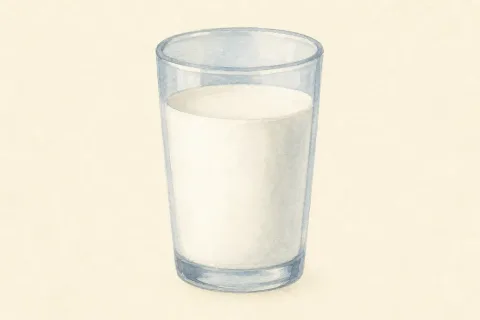
Hear the card:
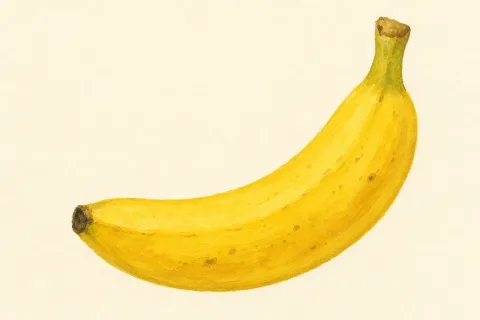
Hear the card:
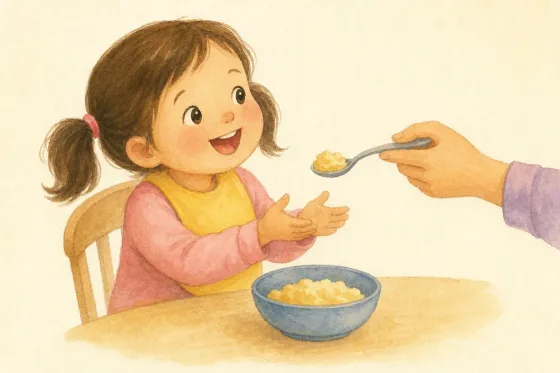
Hear the card:
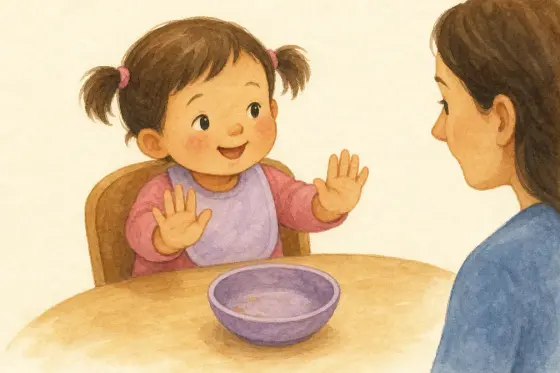
Hear the card:
Print these four cards on one sheet. The sheet has cut lines and needs no account; use your browser’s Print or Save as PDF command.
What to say, in order
- Point to what is there. Show the milk picture beside the real cup and say “milk.” If banana is on the plate, name banana too. Let your child point, look, sign, say a sound, or simply watch.
- When there is a natural reason for more, model the phrase. If your child asks for another piece by reaching or pointing, respond to the request first. You can say “More, please” from the phrase card, then “More banana, please” in your own voice. That longer sentence is your live example; it is not the wording of this free phrase card.
- Close the moment. When your child is finished, show “All done.” Say it while clearing the plate. A gesture or sign for finished counts as a response too.
Do not make food or drink depend on saying a word. A look, reach, gesture, sign, or word can all tell you what your child wants. Serve the food, and use the cards only while the exchange is pleasant.
How the app and paper fit together
The Food & Drink cards include milk and banana. The everyday phrase cards include “More, please.” and “All done.” The page above plays those exact free recordings, so you can try the activity before opening the app. The print sheet lets you put the pictures by the highchair without using a screen at the table.
If the food today is something else, name the real food instead of forcing one of these pictures. The useful pattern is name what is here → respond to a request → mark the ending. It works with a paper card, the app, or no card at all. For more on keeping cards conversational, see how to use flashcards without a quiz.
What this is based on
Sources
- Their First Words, Food & Drink word cards. Milk and banana are in the permanent free set. Word cards
- Their First Words, Everyday phrases. “More, please.” and “All done.” are in the permanent free set. Phrase cards
More guides
Keep reading.
 When do babies say their first words?Around the first birthday, with a wide normal range. What counts, what helps, when to ask.Read the guide · 6 min ›
 Raising a bilingual toddler: what the research says.What the research says about two languages at home, and how to make it work.Read the guide · 7 min ›
 How to use flashcards with a toddler (without turning it into a quiz).Five rules for cards without a quiz — and the research behind each one.Read the guide · 5 min ›
 Is my toddler a late talker? When to worry, and when not to.What the term really means, how many children catch up, and the signs worth a call.Read the guide · 7 min ›
 Does a second language delay a child’s speech?No — and here are the studies to hand to whoever asked.Read the guide · 6 min ›
 How many words should an 18-month-old say?The CDC asks for three words. The typical toddler says about fifty. Both are fine.Read the guide · 5 min ›
 Screen time under two: what the research actually says.The AAP and WHO guidance, the studies behind it, and the one screen that teaches.Read the guide · 6 min ›
- A first words list by age.The categories that often come first across languages, and roughly when, from 12 months to 3.Read the guide · 7 min ›
- A two-language card routine for an ordinary meal.A small English–Spanish meal routine with actual cards and recordings.Read the guide · 5 min ›
Simple Words, Special Moments
Start with one word.
75 words and 35 phrases are free, forever, with both voices. One $9.99 purchase opens the rest of the 1,000+ words and 500+ phrases, in all eight languages at once. No subscription, nothing renews.