A picture book you say out loud
How to use flashcards with a toddler (without turning it into a quiz).
Use cards as pictures to talk about, and follow your child’s interest. These five suggestions are optional activities, not a tested program or a treatment for language delay.
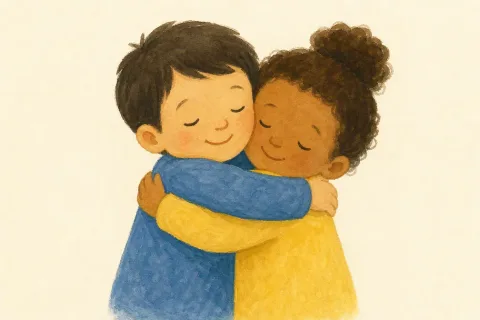
Why flashcards have a bad name
Because of how they are usually used: a grown-up holds up a card, asks “what’s this?”, and the child is tested. For a toddler that is backwards. Language research supports sharing attention and responding to a child.1, 2 A card that arrives as a question is a quiz. A card that arrives as a shared picture, with the word said warmly on top, is a picture book with one page.
A good sign: your child could wander off and nothing would be lost. The card is a prop for a conversation, not a lesson with a pass mark.
Five suggestions
1. Follow their eyes, then name it
Let the child pick the card, or watch which picture they look at, and name that one: “Dog. A big dog.” Talk about what your child notices, rather than steering them back to a card they have left.1
2. Say it yourself, in your voice
If the card has a native voice, play it once so you both hear a clear model — then say the word yourself, looking at your child. Nine-month-olds who heard a new language from a live person in the room learned one of its sound contrasts; the recording groups did not show the same result on that speech-sound test.3 Use the clip as a pronunciation example if it helps you.
3. One word, many mornings
Return to familiar words during everyday routines. Keep the same handful of cards where the moment happens — milk at the highchair, shoe by the door — and let the routine do the repeating.
4. Let two voices say it
A controlled study found that hearing varied speakers helped fourteen-month-olds in a particular word-learning task.4 If a second voice is available — the other parent, a grandparent, the card’s other native voice — use it.
5. Let them be done
When your child turns away, that is a fine place to stop. Phone-based cards still fall under screen guidance; paper cards are an alternative.5, 6 See our screen-time guide for the current recommendations.
What tends to backfire
- Don’t quiz. “What’s this?” puts a toddler on the spot. “Look, a penguin!” invites them in. If they do say it, celebrate lightly and move on.
- Don’t correct. When “dog” comes out as “gog,” say “yes, dog!” They just heard the right word from you at the exact moment it mattered. That is the correction.
- Don’t keep score. Progress can be uneven and hard to see for weeks. A card marked “learned” is a bookmark for you, not a grade for them.
- Share it rather than hand it over. A card, on paper or on a phone, works best as a two-person object. Places like a car seat, a waiting room or an airplane are the exception, and we say so honestly.
Where an app fits, honestly
Paper cards work. An app earns its place only where paper cannot: when the word you need is in a language you do not speak, and you want a native voice to copy before you say it; when you want the same picture to carry two languages for a bilingual home; when you are on a plane. If you use ours, everything above is how it is built — one card at a time, no score, Auto Play off by default, a woman’s and a man’s voice on every card, and Mark Learned as a bookmark. The free words and free phrases are the ones that fit suggestion three: the ordinary, everyday ones.
If the question in your head is the blunter one, are flashcard apps bad for toddlers?, we answer it straight, Auto Play included.
What this is based on
Sources
- Tomasello, M. & Farrar, M. J. (1986). Joint attention and early language. Child Development, 57(6), 1454–1463. doi:10.2307/1130423
- Rowe, M. L. (2012). A longitudinal investigation of the role of quantity and quality of child-directed speech in vocabulary development. Child Development, 83(5), 1762–1774. doi:10.1111/j.1467-8624.2012.01805.x
- Kuhl, P. K., Tsao, F.-M. & Liu, H.-M. (2003). Foreign-language experience in infancy: effects of short-term exposure and social interaction on phonetic learning. PNAS, 100(15), 9096–9101. pnas.org
- Rost, G. C. & McMurray, B. (2009). Speaker variability augments phonological processing in early word learning. Developmental Science, 12(2), 339–349. doi:10.1111/j.1467-7687.2008.00786.x
- World Health Organization (2019). Guidelines on physical activity, sedentary behaviour and sleep for children under 5 years of age. who.int
- American Academy of Pediatrics, Media and children — family media guidance. aap.org
More guides
Keep reading.
 When do babies say their first words?Around the first birthday for many children. What to notice and when to ask.Read the guide · 6 min ›
 Raising a bilingual toddler: what the research says.What the research says about two languages at home, and how to make it work.Read the guide · 7 min ›
 Is my toddler a late talker? When to ask for help.Word counts can raise a concern; they cannot tell you whether your child needs support. Here is who to ask.Read the guide · 5 min ›
 Does a second language delay a child’s speech?No — and here are the studies to hand to whoever asked.Read the guide · 6 min ›
 How many words should an 18-month-old say?What the 18-month checklist can tell you, what it cannot, and when to ask.Read the guide · 3 min ›
 Screen time under two: what the research actually says.Current guidance, limits of the research, and how it applies to our app.Read the guide · 3 min ›
 A first words list by age.The categories that often come first across languages, and roughly when, from 12 months to 3.Read the guide · 7 min ›
 From a mealtime word to a useful phrase.Use four real cards, playable audio, and one printable sheet during a meal.Read the guide · 4 min ›
- A two-language card routine for an ordinary meal.A small English–Spanish meal routine with actual cards and recordings.Read the guide · 5 min ›
 First Spanish words for toddlers: 75 to start with.Seventy-five words by age and topic, each with a native voice to copy — and which five to start with.Read the guide · 6 min ›
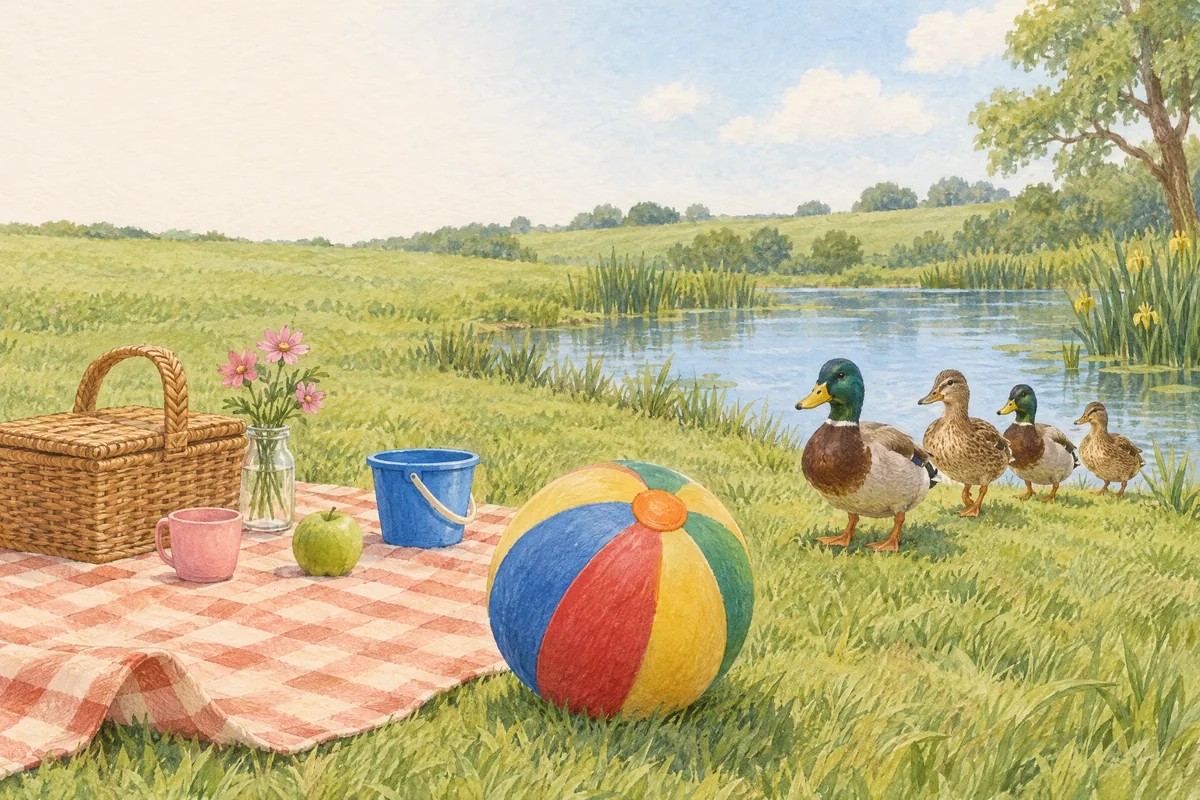 One little picnic: name it, count it, sort it.Four Spanish cards to hear and print, a count, a sort, and one short film — for one ordinary outing.Read the guide · 6 min ›
 Are flashcard apps bad for toddlers? An honest answer.Where the critics are right, where they stop, and where a phone fits in a real parent’s day.Read the guide · 6 min ›
Simple Words, Special Moments
Start with one word.
75 words and 35 phrases are free, forever, with both voices. One $9.99 purchase opens the rest of the 1,000+ words and 500+ phrases, in all eight languages at once. No subscription, nothing renews.