Mamama, then Mama
When do babies say mama and dada? Babble first, then names.
Somewhere around nine months, “mamama” and “dadada” start filling the house. The checklists put the real thing, mama or dada said to a parent, around the first birthday. Here is how to tell the two apart, why dada often seems to arrive first, and when to ask.
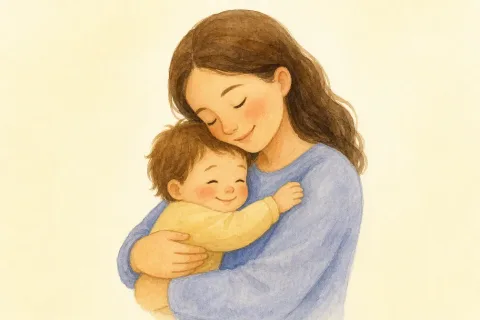
The short answer
There are two milestones inside this question. The first is the sound: long strings like “mamamama” and “bababababa,” which the CDC lists at nine months and ASHA, the professional body for speech-language pathologists, at seven to nine.1, 2 The second is the name. By twelve months, the CDC’s checklist says, a child calls a parent “mama” or “dada” or another special name.3 ASHA and the National Institute on Deafness and Other Communication Disorders both put one or two words, such as mama or dada, around the first birthday.2, 4
The CDC’s milestones describe what most children, 75% or more, can do by that age.3 Roughly, then: the sounds around nine months, the name around one.
Babble first, name later
At nine months, “mamamama” is on the checklist as a sound, not a word.1 That babbling is not wasted. Researchers who study babbling find that, with few exceptions, its sound patterns match the patterns of a baby’s first words.5
What changes around the first birthday is the aim. The CDC’s word is calls.3 That can look like:
- The right name for the right person. “Dada” when dad walks in, and not for the dog or the ceiling fan.
- A call with a purpose. “Mama!” from the crib in the morning, or with both arms up.
- The same sound, day after day. Even if it comes out as “ma” or “da.”
Our first words guide has more on what counts as a word.
They know your name before they say it. In a 1999 study, twenty-four six-month-olds watched videos of their own mother and father on two screens while a voice said “Mommy” or “Daddy,” and their first looks went to the named parent more often than chance. A second group of twenty-four, shown other babies’ parents, showed no such pattern.6, 7 Months before mama is a word in your baby’s mouth, it may already be one in their ear.
Why dada so often seems to come first
If your baby said dada first, you are in good company. A short 1985 paper in the Journal of Child Language opened by noting that, since early in the twentieth century, observers had commented on beginning talkers’ evident preference for words for father over words for mother. One 1948 account said papa came far more often than mama as a first meaningful word. The paper’s proposed explanation was the sounds, not the people.8
The sounds in both names are among the ones babies make most. Across communities, the consonants most often reported in babbling are b and d, m and n, and a few others like w and y, usually in simple consonant-plus-vowel syllables.5 D and m are both on that short list, so a baby who has said “dadada” or “mamama” for months already has the word half made.
Larger, newer data make it a closer race. A study of 970 babies learning English, Mandarin or Cantonese, all eight to sixteen months old and saying one to ten words, found that their first words had striking things in common, along with real differences.9 In all three languages, those first words leaned toward the important people in a baby’s life, mom and dad, along with routines like hi and uh-oh, animals and food.10
Wordbank, an archive of more than 80,000 parent checklists in 29 languages and dialects, goes further. Its authors ranked the words in fifteen of those languages by the age at which half of children say them. The words for mommy and daddy took the top two places in ten. Mommy came first in eleven; daddy led in one, French as spoken in France.10
So dada first is common, and so is mama first. Either way, the checklist counts them as one milestone.3
Why mama and papa sound alike in so many languages
The words themselves seem built for babies. A classic 1959 survey of parent words in a sample of the world’s languages found that languages, related or not, tend to make their words for mother and father from nursery sounds: ma and na for mother, pa and ta for father, more often than other sounds.11
You can hear it across eight languages. Spanish has mamá and papá; French, maman and papa; Portuguese, mamãe and papai; German, Mama and Papa; Italian, mamma and papà; Russian, мама and папа (mama, papa). Korean’s 엄마 and 아빠 (eomma, appa) start with a vowel but carry the same m and p.
Dada but not mama, or the other way around
One name is enough for the milestone. The CDC’s 12-month wording is mama or dada or another special name, and the next checkpoint, at 15 months, is trying one or two words besides mama or dada.3, 12 ASHA’s note is that each child develops in their own way, even within the same family.2
“Another special name” can be a nickname, or the word for mom or dad in the other language at home. The milestones are the same however many languages a child hears, and words count across both languages together.13 Appa counts. So does papá. The bilingual toddler guide has more.
How to answer a “mama”
Answering helps, and timing matters. When researchers asked mothers to respond to their eight-month-olds’ babbling right away, with a smile, a touch and moving closer, the 15 babies in that group began making more mature, more speech-like syllables. Another 15, whose mothers gave the same responses at unrelated moments, showed no change in the quality of their babbling.14
A follow-up with 60 babies of about nine and a half months found more. The 15 whose mothers answered each babble with words began to babble more in the consonant-plus-vowel shape of words, without copying their mothers’ exact sounds. Babies who heard the same words at moments unrelated to their babbling did not change the shape of theirs.15
Over the longer run, the evidence shows a link, not proof of cause. In a study that followed 40 children from nine to twenty-one months, how responsive mothers were at nine and thirteen months predicted when their children reached language milestones, first words among them.16
The CDC’s tips say it plainly: “Repeat your baby’s sounds and say simple words using those sounds.” Another builds on what your baby tries to say, so “ta” gets “Yes, a truck.”1, 3 For mama and dada, that might be:
- The babble, then the name. “Dadada!” back, then “Dada! There’s Dada.”
- Your own name, said often. The CDC’s tips use it too: “Daddy’s back!” when a parent returns, “Mommy is washing your hands” at the sink.1, 3
- Other names in the same breath. “Mama’s at work. Dada’s here. And there’s Grandma.”
When to ask
The checklists give two plain markers: a name for a parent by about 12 months, and one or two other words by about 15.3, 12 If either has not come, if your child stops saying words they used to say, or if something else worries you, the CDC’s advice is not to wait: talk with your child’s doctor and ask about developmental screening.3 In the United States, a child under three can also have a free evaluation through the state’s early intervention program, and you do not need a doctor’s referral to ask for one.17 Our late talker guide explains what an evaluation involves.
Hearing belongs in that conversation. By about nine months to a year, the checklists expect a baby to look when you call their name and to turn toward sounds; if yours does not, that is worth mentioning to the doctor.1, 2, 4 A hearing test is often part of a speech and language evaluation, because a hearing problem can affect how speech develops.4 Hearing loss can also begin after birth, and the CDC’s advice for anyone who thinks a child might not hear well is to ask the doctor for a hearing test as soon as possible.18
Learning two languages does not cause speech or language problems, so a bilingual home is not a reason to wait.13
A name to say back
In Their First Words, mama and dada are free cards in all eight of these languages, each with a woman’s and a man’s native voice; you can find them on the People page. For a baby under one, the app is for you, not your baby. Its First Words stage covers birth to two years, and at this age it works as a prompt list: the picture, the written word and a native voice to copy, handy when the word in your second language is the one you are less sure of. Then the phone goes down, and the name your baby hears is said by you.
In short
Questions parents ask.
When do babies say mama and dada?
Usually in two steps. Babbled strings like “mamamama” tend to appear around seven to nine months. Using mama or dada as a name for a parent comes around the first birthday: the CDC lists “calls a parent ‘mama’ or ‘dada’ or another special name” at 12 months, a skill most children have by then. Each child’s timing is their own, a little earlier or a little later.
Why do babies say dada first?
Plenty do, and people have been noticing it for more than a hundred years. One explanation researchers have offered is the sounds: d and b are among the consonants babies babble most, along with m and n. In large modern samples the race is close, and the word for mommy often comes first. The milestone checklists do not ask which comes first.
My baby says dada but not mama. Is that normal?
Yes. The 12-month milestone asks for one name for a parent, “mama” or “dada” or another special name, not both. The next checkpoint, at 15 months, is one or two words besides mama or dada. If neither name has come by around the first birthday, that is worth mentioning to the doctor. If words your baby used to say have gone, that is worth a call to the doctor soon, without waiting for the next checkup.
When do babies say mama with meaning?
Around the first birthday for many babies. The difference is the aim: “mamamama” at nine months is play with sounds, while a “mama” with meaning is said to you, when you walk in or when they want you. Understanding comes earlier: in one study, six-month-olds already looked toward the right parent when they heard “Mommy” or “Daddy.”
What this is based on
Sources
- CDC, Milestones by 9 Months (reviewed May 2026): makes a lot of different sounds like “mamamama” and “bababababa”; looks when you call her name; tips to repeat your baby’s sounds and say simple words using them, and “Daddy’s back!” cdc.gov
- American Speech-Language-Hearing Association, Communication Milestones: Birth to 1 Year: looks at you when you call their name and babbles long strings of sounds (7–9 months); says one or two words, like mama, dada, hi and bye (10–12 months); each child develops uniquely. asha.org
- CDC, Milestones by 1 Year (reviewed May 2026): calls a parent “mama” or “dada” or another special name; milestones as what most children (75% or more) can do; act early on missed milestones, lost skills or other concerns; parent tips. cdc.gov
- National Institute on Deafness and Other Communication Disorders, Speech and Language Developmental Milestones: turns and looks in the direction of sounds (7 months to 1 year); one or two words (“Hi,” “dog,” “Dada,” or “Mama”) by the first birthday; a hearing test is often part of the evaluation. nidcd.nih.gov
- Davis, B. L. & MacNeilage, P. F. (1995). The articulatory basis of babbling. Journal of Speech and Hearing Research, 38(6), 1199–1211. PMID 8747814
- Tincoff, R. & Jusczyk, P. W. (2012). Six-month-olds comprehend words that refer to parts of the body. Infancy, 17(4), 432–444; its abstract summarizes Tincoff & Jusczyk (1999), Psychological Science, 10(2), 172–175, on “Mommy” and “Daddy.” PMID 32693484
- Johns Hopkins University (1999). “Mama! Dada!” Origin of language pegged at 6 months. ScienceDaily, February 17, 1999: two experiments with 24 six-month-olds each. sciencedaily.com
- Locke, J. L. (1985). The role of phonetic factors in parent reference. Journal of Child Language, 12(1), 215–220. doi:10.1017/S0305000900006334
- Tardif, T., Fletcher, P., Liang, W., Zhang, Z., Kaciroti, N. & Marchman, V. A. (2008). Baby’s first 10 words. Developmental Psychology, 44(4), 929–938. PMID 18605825
- Frank, M. C., Braginsky, M., Yurovsky, D. & Marchman, V. A. (2021). Variability and Consistency in Early Language Learning: The Wordbank Project. MIT Press. Preface (more than 82,000 checklists in 29 languages or dialects) and Chapter 8, Consistency in Early Vocabulary, Table 8.1 (earliest = the age at which half of children are estimated to produce the word). langcog.github.io/wordbank-book
- Murdock, G. P. (1959). Cross-language parallels in parental kin terms. Anthropological Linguistics, 1, 1–5; summary and tested hypotheses in Yale’s Human Relations Area Files. hraf.yale.edu
- CDC, Milestones by 15 Months (reviewed May 2026): tries to say one or two words besides “mama” or “dada.” cdc.gov
- AAP and ASHA, Young Children Learning Multiple Languages: Parent FAQs (updated November 2025): the same milestones however many languages; count words across languages; multiple languages do not cause speech or language problems. healthychildren.org
- Goldstein, M. H., King, A. P. & West, M. J. (2003). Social interaction shapes babbling: testing parallels between birdsong and speech. PNAS, 100(13), 8030–8035. PMC164707
- Goldstein, M. H. & Schwade, J. A. (2008). Social feedback to infants’ babbling facilitates rapid phonological learning. Psychological Science, 19(5), 515–523. PMID 18466414
- Tamis-LeMonda, C. S., Bornstein, M. H. & Baumwell, L. (2001). Maternal responsiveness and children’s achievement of language milestones. Child Development, 72(3), 748–767. PMID 11405580
- CDC, Concerned About Your Child’s Development? (reviewed February 2026): early intervention for children under three, a free evaluation, no referral needed. cdc.gov
- CDC, Screening for Hearing Loss: hearing loss that develops after birth, and asking the doctor for a hearing test as soon as possible if you think a child might have hearing loss. cdc.gov
Simple Words, Special Moments
Start with one word.
75 words and 35 phrases are free, forever, with both voices. One $9.99 purchase opens the rest of the 1,000+ words and 500+ phrases, in all eight languages at once. No subscription, nothing renews.
More guides
Keep reading.
 What should a 6-month-old be saying? Sounds, not words yet.Why no words at six months is normal, what the babbling is building, and how to talk back.Read the guide · 6 min ›
 When do babies say their first words?Around the first birthday for many children. What to notice and when to ask.Read the guide · 6 min ›
 Baby and Toddler First Words: Lists, Pictures & AudioTwelve first words to see and hear, small sets to print, and everyday ways to use them together.Read the guide · 9 min ›
Choosing an app? Our guides to the best first words app for babies (and why it is really for you).