 Their First Words
Home › Guides › Two-language card routine
One picture, two ways to say it
A two-language card routine for an ordinary meal.
Pick one picture that belongs to the meal in front of you. Hear it in both languages, say it in the language you normally use with your child, and return to the food. Here is a concrete English–Spanish example you can adapt.

The short routine
Use one or two cards that match what is actually happening. This example uses the app’s English and Spanish text and recordings; both languages are on the same free card. If your family uses another pair, the app’s language pages show its available card languages. A parent or caregiver stays in the conversation; the recording is there so the adult can check a word and say it aloud.
- Before the meal: choose milk or banana if it is being served. Listen once in the language you want to check. Put the device down or use a printed card.
- At the table: hold the picture next to the real thing. Say your everyday word, such as “leche” or “milk.” If another adult uses the other language, they can name the same thing in their own turn. There is no need to demand both words from the child.
- When your child asks for more: respond to the point, gesture, sign, or word. Model “Más, por favor” or “More, please” naturally as you serve more. The phrase card below gives you the exact wording and both recordings.
- Later: use the same picture at another ordinary meal. Notice whether the child points to it, names it, or asks for more in either language; none is a test to pass.
One picture can carry both words. A child may answer in whichever language comes first. Continue the exchange in the language you normally speak; you do not need to correct the language choice or withhold the requested food.
Four real cards to try
These are the exact English and Spanish labels in Their First Words. Each picture and both recordings are from a published free card. “Spoon” works when you set the table; skip it when it is not relevant.
English
Español

English
Español
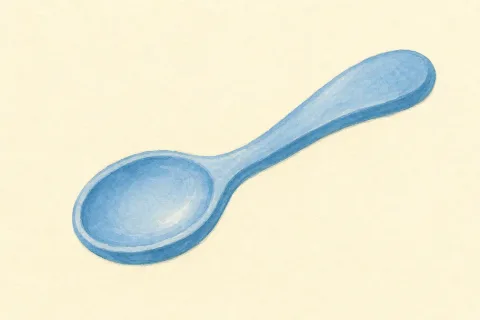
English
Español
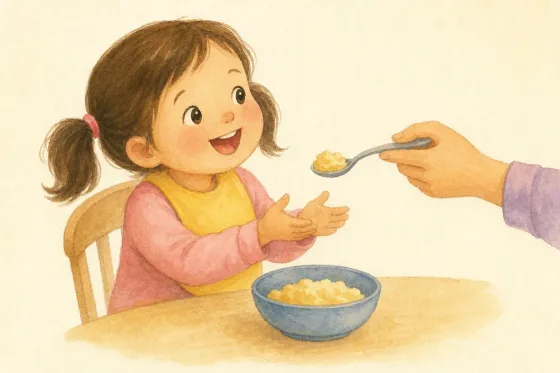
English
Español
Make it work in your home
If Spanish is the language you are trying to keep present at home, give it a real job in the routine: setting out the spoon, serving the banana, calling a relative after dinner. If English is the less-used language in your home, reverse the example. The point is a useful exchange with a person, not an equal number of turns in each language.
The Spanish card page shows more exact word and phrase examples, and the Spanish printable set gives you paper cards. The same free cards and both voices are in Their First Words when you want to listen and play together. For the broader questions about mixing languages and milestones, read raising a bilingual toddler and the bilingual language-delay guide; this activity is a practical companion to those sourced guides, not a developmental assessment.
What this is based on
Sources
- Their First Words, Spanish cards. The published word and phrase examples supply the text, images, and recordings above. Spanish cards
- Their First Words, Raising a bilingual toddler. Background guide with named research sources. Bilingual guide
More guides
Keep reading.
 When do babies say their first words?Around the first birthday, with a wide normal range. What counts, what helps, when to ask.Read the guide · 6 min ›
 Raising a bilingual toddler: what the research says.What the research says about two languages at home, and how to make it work.Read the guide · 7 min ›
 How to use flashcards with a toddler (without turning it into a quiz).Five rules for cards without a quiz — and the research behind each one.Read the guide · 5 min ›
 Is my toddler a late talker? When to worry, and when not to.What the term really means, how many children catch up, and the signs worth a call.Read the guide · 7 min ›
 Does a second language delay a child’s speech?No — and here are the studies to hand to whoever asked.Read the guide · 6 min ›
 How many words should an 18-month-old say?The CDC asks for three words. The typical toddler says about fifty. Both are fine.Read the guide · 5 min ›
 Screen time under two: what the research actually says.The AAP and WHO guidance, the studies behind it, and the one screen that teaches.Read the guide · 6 min ›
- A first words list by age.The categories that often come first across languages, and roughly when, from 12 months to 3.Read the guide · 7 min ›
- From a mealtime word to a useful phrase.Use four real cards, playable audio, and one printable sheet during a meal.Read the guide · 4 min ›
Simple Words, Special Moments
Start with one word.
75 words and 35 phrases are free, forever, with both voices. One $9.99 purchase opens the rest of the 1,000+ words and 500+ phrases, in all eight languages at once. No subscription, nothing renews.