Home › Guides › First Italian words
Italian at home, one word at a time
First Italian words for toddlers: 75 to start with.
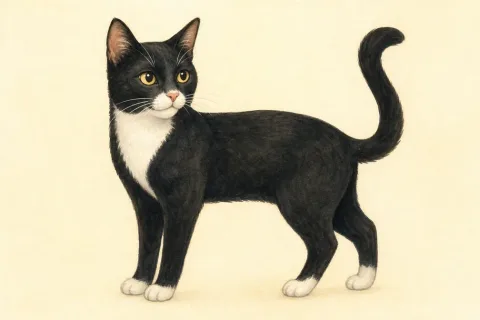
Milk (latte) at breakfast. A cat (gatto) on the windowsill. A ball (palla) at the park. These are good places to begin with Italian. Here are 75 words, with the English beside each and a native voice to copy, plus a small set to try first.
Start with what they can see
Research on early words gives a family adding Italian a place to begin. A study that asked mothers of twenty-month-olds in seven countries, Italy among them, to fill in matching word checklists found that in every language, names for things made up the biggest share of children’s words, except among children just starting to talk.1
Italian toddlers add a warm twist. A study of 386 Italian and 1,001 American children aged eighteen to thirty months found that names for things, action and describing words, and small grammar words grew in much the same way in both languages. The Italian children had a somewhat larger share of social words, though: names for people, sound effects and little routines, especially while they knew fewer than two hundred words. The authors suspected a family reason: Italian families often lived in the same city as their relatives, so there were more people to name and more of them to play the little games.2 So mamma, papà, the cat and the milk make a good start, with a ciao for whoever comes through the door.
Five to try: latte (milk), mamma, papà, palla (ball), gatto (cat). A favorite toy or a different food can take the place of one your family rarely uses.
Words in both languages count. Bilingual children are no more likely than other children to have trouble with language, and with both languages counted together they know about as many words as children learning one.3 An evaluation should look at every language a child uses,3, 4 and the standard parent word checklist has an Italian version, Il Primo Vocabolario del Bambino, whose words-and-sentences form has Italian norms for children aged eighteen to thirty-six months, so a check can happen in Italian too.5 The bilingual toddler guide explains more.
How Italian sounds
Italian is spelled much as it sounds, so once a few patterns are familiar, most cards can be read aloud. In standard Italian every vowel is said, the last one included: cane is two syllables, KAH-neh, and latte is LAHT-teh. The native voice is the best guide. A few things to listen for:
- Five vowel letters, seven vowel sounds. a, i and u are roughly the vowels in “father”, “machine” and “rule”. e sits near “bed” or “day”, and o near “more” or “go”, without the glide English adds at the end. In a stressed syllable each comes open or closed, which makes seven sounds in all: the o of cuore is open, the o of fiore closed. Regions differ on which is which, so a grandparent may say a word a little differently from the card.6
- Double letters, held longer. Words like gatto, palla and mamma hold the doubled consonant a beat, and the length can change the meaning:7 nonno is grandpa, while nono means ninth.
- Hard and soft c and g. Before a, o or u they are hard, as in cane, cuore and gatto. Before e or i they soften to “ch” and “j”: cucina is “coo-CHEE-na” and mangiare is “man-JAH-reh”. An h keeps them hard, so macchina is “MAHK-kee-na”; on its own, h is silent, as in Ho finito.
- gn, gli, sc and z. gn is the “ny” in “canyon”: montagna. gli is close to the “lli” in “million”: orgoglioso, Ti voglio bene. sc is “sh” before e or i, so scienziata starts “shen-”, and “sk” otherwise, as in scarpa. z is “ts” or “dz”: pizza, and zoo, which is two syllables, DZOH-oh.
- A tapped or rolled r. The tip of the tongue flicks once, like the quick tt in an American “butter”, or rolls, as in treno and fiore, and a double rr rolls longer, as in arrampicarsi.7
- Stress near the end. Most Italian words stress the second-to-last syllable: PAHL-lah, GAHT-toh, MAH-noh.8 When the last syllable takes the stress, a written accent shows it: papà, bebè, iglù.9 It matters: papa, stressed on the first syllable, is the pope. Some words stress earlier with no mark, such as macchina and albero. The same letters can even make two words: the ancora of Ancora, per favore is ahn-KOH-rah, while AHN-koh-rah is an anchor.8
The 75 words
These are the free words from Their First Words in Italian, in the three stages the app uses. Every word has two native voices, a woman’s and a man’s, so you can hear it before trying it yourself. Action words are in their dictionary form, such as mangiare and saltare; in a sentence the ending changes. Describing words follow who they describe: the card says emozionato and orgoglioso, and about a girl they become emozionata and orgogliosa; the scientist on the card is a woman, so it says scienziata. The same 75, plus 35 everyday phrases, are also free printable Italian flashcards, with English as an optional second language.
Voice for every card on this page:
First Words 0–24 months · 25 words
| Italian | English | Hear it |
|---|---|---|
| cane | dog | |
| gatto | cat | |
| anatra | duck | |
| latte | milk | |
| banana | banana | |
| mano | hand | |
| cucchiaio | spoon | |
| scarpa | shoe | |
| palla | ball | |
| orsacchiotto | teddy bear | |
| macchina | car | |
| treno | train | |
| albero | tree | |
| fiore | flower | |
| parco | park | |
| mamma | mama | |
| papà | dada | |
| bebè | baby | |
| mangiare | eat | |
| abbracciare | hug | |
| rosa | pink | |
| due | two | |
| cuore | heart | |
| felice | happy | |
| finito | done |
Growing Words 2–3 years · 25 words
| Italian | English | Hear it |
|---|---|---|
| pinguino | penguin | |
| dinosauro | dinosaur | |
| delfino | dolphin | |
| pizza | pizza | |
| fronte | forehead | |
| cucina | kitchen | |
| occhiali da sole | sunglasses | |
| puzzle | puzzle | |
| camion dei pompieri | fire truck | |
| nave | ship | |
| arcobaleno | rainbow | |
| oceano | ocean | |
| montagna | mountain | |
| zoo | zoo | |
| castello | castle | |
| amico | friend | |
| dipingere | painting | |
| saltare | jump | |
| arrampicarsi | climb | |
| lavarsi i denti | brush teeth | |
| viola | purple | |
| undici | eleven | |
| rombo | diamond | |
| emozionato | excited | |
| piano | gentle |
Word Builder 3–5 years · 25 words
| Italian | English | Hear it |
|---|---|---|
| pavone | peacock | |
| zucchina | zucchini | |
| cervello | brain | |
| calamita | magnet | |
| torcia | flashlight | |
| acquario | aquarium | |
| uniforme | uniform | |
| trampolino | trampoline | |
| astronave | spaceship | |
| auto da corsa | race car | |
| mappamondo | globe | |
| vulcano | volcano | |
| iglù | igloo | |
| astronauta | astronaut | |
| scienziata | scientist | |
| artista | artist | |
| principessa | princess | |
| supereroe | superhero | |
| fare finta | pretend | |
| chiedere scusa | apologize | |
| lavanda | lavender | |
| venti | twenty | |
| cubo | cube | |
| orgoglioso | proud | |
| tra | between |
The little word in front
Every Italian noun is masculine or feminine. Most words ending in -o are masculine, most ending in -a are feminine, and those ending in -e can be either: il cane, but la nave. The cards show the word on its own; in a sentence, Italian adds il or la for “the” and un or una for “a”. For the five to try, that is il latte, la mamma, il papà, la palla and il gatto, or un gatto and una palla.
A few words go their own way: mano ends in -o but is feminine, which is why a parent says Dammi la mano. Some take other forms of “the”: l’albero, lo zoo, gli occhiali da sole. In the plural, -o usually becomes -i and -a becomes -e: due gatti, due palle. A slipped article is part of learning, for you and for your child.
Tu, family words and baby talk
Italian has two ways to say “you” to one person. A child uses tu, the familiar one, with parents and family; Lei, the polite form for less familiar grown-ups, can wait. Italian usually leaves the word tu unsaid, so in the lines marked tu below it shows in vuoi, dammi, dormi and the ti of Ti voglio bene. All eight are free:
| Italian | English | Hear it |
|---|---|---|
| Ancora, per favore. | More, please.child to a grown-up | |
| Grazie. | Thank you.child to a grown-up | |
| Ho finito. | All done.child to a grown-up | |
| Ti voglio bene. | I love you.child to a grown-up · tu | |
| Questa è la mia mamma. | This is my mommy.child, introducing Mom | |
| Vuoi giocare? | Do you want to play?child to a friend · tu | |
| Dammi la mano. | Hold my hand.grown-up to a child · tu | |
| Buonanotte, dormi bene. | Good night, sleep tight.grown-up to a child · tu |
The “I love you” card says Ti voglio bene, what a parent says to a child and a child says back; ti amo is for partners.
The everyday words for parents are mamma and papà, and the grandparents are nonna and nonno. In Tuscany, many families say babbo for dad; all of Italy knows the word from Babbo Natale, Santa Claus. Italian also loves a fond little ending: orsacchiotto, the teddy bear card, is orso (bear) made small, and a kitten is a gattino, a little gatto. At the curb, Dammi la mano often becomes Dammi la manina, the little hand. Baby talk has its own words: la pappa for a meal, la nanna for sleep, la bua for a boo-boo.
Using them in an ordinary day
A few Italian words can fit into a routine you already have. Here is what that might sound like:
- Breakfast: latte (milk), banana, cucchiaio (spoon), Ancora, per favore (more, please) when the bowl is empty, and Ho finito (all done) at the end. The mealtime guide walks through exactly this.
- Getting dressed: scarpa (shoe), mano (hand), and finito (done) when the shoes are on.
- The park: parco (park), albero (tree), fiore (flower), anatra (duck), cane (dog), palla (ball).
- Bedtime: orsacchiotto (teddy bear), abbracciare (hug), and Buonanotte, dormi bene (good night, sleep tight) at lights-out.
Your child’s interest gives you an opening: “gatto” when they spot a cat, then a few seconds for a reply.10 A point, a sound or “cat” keeps the exchange going; you can answer with the Italian word again. The two-language card routine shows how that can work with a picture beside the real meal.
Nonna, Saturday school and the parent who chose Italian
For many families, the grandparents are the reason: a child who can talk to nonna and nonno. A video call goes better when a toddler has something to say on cue: Ti voglio bene (I love you), Grazie (thank you), or Questa è la mia mamma (this is my mommy) when Mom leans into the frame. A week of saying them at bedtime gives Sunday’s call somewhere to start, whether the call goes home to Palermo or to the next state.
If the Italian in your family came over with grandparents or great-grandparents, it may have been Sicilian, Neapolitan or another regional language rather than the standard Italian on these cards. Italy’s dialects are still widely spoken: in a 2015 national survey, about a third of people in Italy aged six and over used both Italian and a dialect with their family, and 14% mostly a dialect.11 In parts of the south, the last vowel of a word often fades to a soft “uh”, one reason a family word can sound clipped beside the card.6 The cards use standard Italian, the Italian of school; a great-grandmother’s word can sit right beside it. Both belong to your family.
Saturday Italian school or a bilingual preschool gives the words more places to live, and more speakers mean more of the day in Italian. In a study of twenty-nine Spanish–English two-year-olds, the share of the day each language filled predicted the child’s vocabulary in it, and for English, so did the number of different people the child heard it from.12 A teacher, a grandparent and a family friend each add time in Italian and another voice. A minute with four cards at breakfast is not homework.
When only one parent speaks Italian, the home language has fewer voices. In a survey of 1,899 families with children aged six to ten, in which at least one parent spoke a minority language, the best odds of a child speaking it came when both parents used it and no more than one also spoke the community language; “one parent, one language” was neither necessary nor sufficient.13 In a mixed home, the Italian speaker’s minutes, and the grandparents’, carry more of the weight. The other parent does not need to switch; the AAP’s advice is to use the language you are most comfortable with.4 Knowing mamma, papà and Ancora, per favore well enough to answer them is a warm way to join in.
And if neither of you grew up with Italian and you chose it anyway, for a partner’s family or for love of the language, our guide to teaching a language you don’t speak covers what the research says. If your own Italian went quiet after childhood, you are far from alone: home languages are more likely than the community language to fade as children grow.3 The native voices on this page give you the word to borrow.
Paper, app, or both
The printable cards are free, with no sign-up, and can live on the fridge or beside a favorite book. The app starts with the same free words and phrases: the picture, the written word and a woman’s and a man’s native voice on every card, so the word is ready before the moment arrives. It has no ads and works offline; one $9.99 purchase opens the rest of the 1,000+ words and 500+ phrases, in all eight languages. Both are there for the word; the conversation over breakfast is yours. Neither is a treatment for language delay. The same 75 words in Spanish, with their own sound notes, are in our first Spanish words guide. You can come back to this page whenever you want to hear a word again.
In short
Questions parents ask.
What Italian words should a toddler learn first?
Familiar people, food and everyday things are useful starting points: mamma, papà, latte (milk), banana, palla (ball) and gatto (cat), with ciao for hello and goodbye. In a seven-country study that included Italian, names for things made up the largest share of twenty-month-olds’ words in every language, except among children just starting to talk. Words for things your child notices give you something to talk about together.
How do I teach my toddler Italian if I don’t speak it?
A few words tucked into routines you already have make a good start: latte (milk) at breakfast, scarpa (shoe) at the door, orsacchiotto (teddy bear) at bedtime. The native voices on this page give you a pronunciation to copy, and your accent does not have to be perfect. Other people who speak Italian, such as a grandparent on a video call or the teachers at a Saturday school or bilingual preschool, add more Italian and more voices. Our guide to teaching a language you don’t speak goes further.
Will Italian at home slow down my toddler’s English?
No. Learning more than one language does not cause a speech or language problem, and an evaluation should consider every language your child uses. Counted across Italian and English together, with a word known in both languages counted once, bilingual toddlers know about as many words as toddlers learning one language. A word in either language counts.
What are some Italian baby words?
Italian has its own baby talk, heard in many homes: la pappa for a meal, la nanna for sleep (fare la nanna is going night-night) and la bua for a boo-boo. Little endings make words fond: la manina is a small hand, and gattino a kitten. Everyday first words such as mamma, papà and latte (milk) are in the tables above, each with a native voice.
What this is based on
Sources
- Bornstein, M. H., Cote, L. R., Maital, S., Painter, K., Park, S.-Y., Pascual, L., Pêcheux, M.-G., Ruel, J., Venuti, P. & Vyt, A. (2004). Cross-linguistic analysis of vocabulary in young children: Spanish, Dutch, French, Hebrew, Italian, Korean, and American English. Child Development, 75(4), 1115–1139. PMID 15260868
- Caselli, C., Casadio, P. & Bates, E. (1999). A comparison of the transition from first words to grammar in English and Italian. Journal of Child Language, 26(1), 69–111. PMID 10217890
- Byers-Heinlein, K. & Lew-Williams, C. (2013). Bilingualism in the early years: what the science says. LEARNing Landscapes, 7(1), 95–112. PMC6168212
- AAP and ASHA, Young Children Learning Multiple Languages: Parent FAQs (updated November 2025) — a speech or language problem shows up in every language; use the language you are most comfortable with. healthychildren.org
- Rinaldi, P., Pasqualetti, P., Stefanini, S., Bello, A. & Caselli, M. C. (2019). The Italian Words and Sentences MB-CDI: normative data and concordance between complete and short forms. Journal of Child Language, 46(3), 546–566. PMID 30773152
- Calamai, S. (2011). Vocali. In Enciclopedia dell’Italiano. Istituto della Enciclopedia Italiana Treccani — seven vowels in stressed syllables, five elsewhere. treccani.it
- Gili Fivela, B. (2010). Consonanti. In Enciclopedia dell’Italiano. Istituto della Enciclopedia Italiana Treccani — single and double consonants differ in meaning; r as one or several quick taps. treccani.it
- Gili Fivela, B. (2010). Accento. In Enciclopedia dell’Italiano. Istituto della Enciclopedia Italiana Treccani — most words stress the second-to-last syllable; papa and papà, àncora and ancora. treccani.it
- Demartini, S. (2010). Accento grafico. In Enciclopedia dell’Italiano. Istituto della Enciclopedia Italiana Treccani — the written accent on a final stressed vowel. treccani.it
- Tomasello, M. & Farrar, M. J. (1986). Joint attention and early language. Child Development, 57(6), 1454–1463. PMID 3802971
- Istat (2017). L’uso della lingua italiana, dei dialetti e di altre lingue in Italia. Anno 2015 — language used with family by people aged six and over: 45.9% mainly Italian, 32.2% both Italian and dialect, 14% mainly dialect. istat.it
- Place, S. & Hoff, E. (2011). Properties of dual language exposure that influence 2-year-olds’ bilingual proficiency. Child Development, 82(6), 1834–1849. PMC4144198
- De Houwer, A. (2007). Parental language input patterns and children’s bilingual use. Applied Psycholinguistics, 28(3), 411–424. doi:10.1017/S0142716407070221
Simple Words, Special Moments
Start with one word.
75 words and 35 phrases are free, forever, with both voices. One $9.99 purchase opens the rest of the 1,000+ words and 500+ phrases, in all eight languages at once. No subscription, nothing renews.
More guides
Keep reading.
 Can I teach my child a language I don’t speak?Why your accent is probably not the worry, what a native speaker adds, and how a few real exchanges a day can start a second language.Read the guide · 8 min ›
 Raising a bilingual toddler: what the research says.Why mixing is normal, how vocabulary grows, and where two languages fit into family life.Read the guide · 7 min ›
 A two-language card routine for an ordinary meal.Milk, banana, spoon and More, please: four cards for an ordinary meal in two languages.Read the guide · 5 min ›
Choosing an app? Our guides to the best first words app for bilingual families and the best English app for toddlers with another home language.