Home › Guides › First Korean words
Korean at home, one word at a time
First Korean words for toddlers: 75 to start with.
Milk (우유 uyu) at breakfast. Shoes (신발 sinbal) at the door. A duck (오리 ori) at the park. These are good places to begin with Korean. Here are 75 words in Hangul, with the romanization and English beside each and a native voice to copy, plus a small set to try first.
Start with what they can see
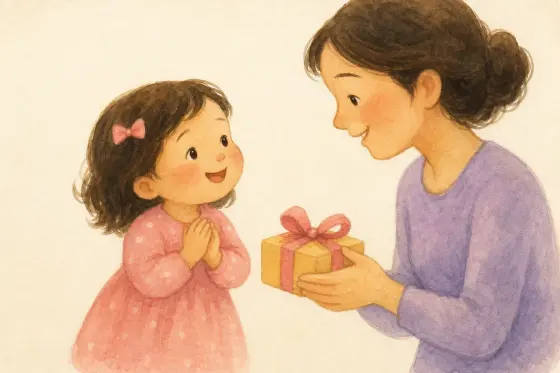
Research on first words gives a family adding Korean a place to begin. A study of English, Cantonese and Mandarin learners aged eight to sixteen months found that babies’ first words had much in common across languages, though the share of names for things, people words and action words differed from one language to the next.1 A study that did include Korean asked mothers of twenty-month-olds in seven countries to fill in matching word checklists: in every language, names for things made up the biggest share of children’s words, except among children just starting to talk.2
Korean adds a twist. In a small study of Korean- and English-learning toddlers, both groups had more nouns than verbs at fifty words, but the Korean learners had more verbs than the English learners, and their caregivers talked more about actions.3 So people, food and things in the room make a good start, with an action word such as 먹다 meokda (eat) alongside.
Five to try: 우유 uyu (milk), 엄마 eomma (mom), 아빠 appa (dad), 공 gong (ball), 신발 sinbal (shoe). A favorite toy or a different food can take the place of one your family rarely uses.
Words in both languages count. Bilingual children are no more likely than other children to have trouble with language, and with both languages counted together they know about as many words as children learning one.4 An evaluation should look at every language a child uses,4, 5 and the standard parent word checklist has a Korean version, with Korean norms and short forms for screening, so a check can happen in Korean too.6 The bilingual toddler guide explains more.
How Korean sounds and reads
Each word here comes with its Revised Romanization. That is South Korea’s official system, and it follows the sound rather than the spelling, so 공룡 (dinosaur) is written gongnyong.7 It is a bridge for the first weeks; the native voice is a better guide than any spelling. A few things to listen for:
- Letters in syllable blocks. Hangul is an alphabet whose letters sit in one block per syllable: 엄마 is 엄 and 마, with an ㅁ (m) in each. A circle at the start of a block is silent, so 아기 agi (baby) begins on the vowel; at the end of a block it says ng, as in 공 gong (ball).
- The vowels spelled eo and eu. eo (ㅓ) is close to the vowel in “up”, so eomma sounds like “um-ma”. eu (ㅡ) is “oo” with the lips spread flat; Korean often adds it to words borrowed from English, so heart becomes 하트 hateu.
- Three kinds of b and p. 바나나 banana starts with a plain ㅂ, between an English b and p; 아빠 appa has a tense ㅃ, held tight with no puff of air; 피자 pija starts with a breathy ㅍ. Tense letters are doubled in the romanization: pp, and kk in 꽃 kkot (flower).
- One letter for r and l. ㄹ is a quick tap between vowels, as in 오리 ori (duck), and an l at the end, as in 둘 dul (two).
- Two sets of numbers. 둘 dul, 열하나 yeolhana (eleven) and 스물 seumul (twenty) are native Korean numbers, used for counting things and for saying how old someone is; 열하나 is ten plus one, and before a counting word two shortens, so a two-year-old is 두 살 du sal. A second set, borrowed from Chinese, covers dates, money and phone numbers.
The 75 words
These are the free words from Their First Words in Korean, in the three stages the app uses. Every word has two native voices, a woman’s and a man’s, so you can hear it before trying it yourself. Action and feeling words are in their dictionary form, ending in -다; in conversation the ending changes. The same 75, plus 35 everyday phrases, are also free printable Korean flashcards, with English as an optional second language.
Voice for every card on this page:
First Words 0–24 months · 25 words
| Korean | English | Hear it |
|---|---|---|
| 개gae | dog | |
| 고양이goyangi | cat | |
| 오리ori | duck | |
| 우유uyu | milk | |
| 바나나banana | banana | |
| 손son | hand | |
| 숟가락sutgarak | spoon | |
| 신발sinbal | shoe | |
| 공gong | ball | |
| 곰인형gominhyeong | teddy bear | |
| 차cha | car | |
| 기차gicha | train | |
| 나무namu | tree | |
| 꽃kkot | flower | |
| 공원gongwon | park | |
| 엄마eomma | mama | |
| 아빠appa | dada | |
| 아기agi | baby | |
| 먹다meokda | eat | |
| 안다anda | hug | |
| 분홍bunhong | pink | |
| 둘dul | two | |
| 하트hateu | heart | |
| 행복하다haengbokada | happy | |
| 끝kkeut | done |
Growing Words 2–3 years · 25 words
| Korean | English | Hear it |
|---|---|---|
| 펭귄penggwin | penguin | |
| 공룡gongnyong | dinosaur | |
| 돌고래dolgorae | dolphin | |
| 피자pija | pizza | |
| 이마ima | forehead | |
| 부엌bueok | kitchen | |
| 선글라스seon-geullaseu | sunglasses | |
| 퍼즐peojeul | puzzle | |
| 소방차sobangcha | fire truck | |
| 큰 배keun bae | ship | |
| 무지개mujigae | rainbow | |
| 바다bada | ocean | |
| 산san | mountain | |
| 동물원dongmurwon | zoo | |
| 성seong | castle | |
| 친구chingu | friend | |
| 그림 그리다geurim geurida | painting | |
| 점프하다jeompeuhada | jump | |
| 오르다oreuda | climb | |
| 양치하다yangchihada | brush teeth | |
| 보라bora | purple | |
| 열하나yeolhana | eleven | |
| 마름모mareummo | diamond | |
| 신나다sinnada | excited | |
| 살살salsal | gentle |
Word Builder 3–5 years · 25 words
| Korean | English | Hear it |
|---|---|---|
| 공작새gongjaksae | peacock | |
| 주키니호박jukinihobak | zucchini | |
| 뇌noe | brain | |
| 자석jaseok | magnet | |
| 손전등sonjeondeung | flashlight | |
| 어항eohang | aquarium | |
| 유니폼yunipom | uniform | |
| 트램펄린teuraempeollin | trampoline | |
| 우주선ujuseon | spaceship | |
| 경주차gyeongjucha | race car | |
| 지구본jigubon | globe | |
| 화산hwasan | volcano | |
| 이글루igeullu | igloo | |
| 우주비행사ujubihaengsa | astronaut | |
| 과학자gwahakja | scientist | |
| 예술가yesulga | artist | |
| 공주gongju | princess | |
| 슈퍼히어로syupeohieoro | superhero | |
| 하는 척하다haneun cheokada | pretend | |
| 사과하다sagwahada | apologize | |
| 연보라yeonbora | lavender | |
| 스물seumul | twenty | |
| 큐브kyubeu | cube | |
| 자랑스럽다jarangseureopda | proud | |
| 사이sai | between |
Polite endings and family words
Korean changes the end of a sentence to fit the listener. For a toddler, one ending does most of the work: -요 -yo, the everyday polite level, which children learn to use with grown-ups, grandparents included. Parents talk to small children in the plain form, 반말 banmal; children use it with each other, and many toddlers still use it with their own parents:
| Korean | English | Hear it |
|---|---|---|
| 더 주세요.deo juseyo | More, please.child to a grown-up · polite | |
| 고마워요.gomawoyo | Thank you.child to a grown-up · polite | |
| 사랑해요.saranghaeyo | I love you.child to a grown-up · polite | |
| 다 했어요.da haesseoyo | All done.child to a grown-up · polite | |
| 같이 놀래?gachi nollae? | Do you want to play?child to a friend · plain | |
| 내 손 잡아.nae son jaba | Hold my hand.grown-up to a child · plain | |
| 잘 자, 푹 자.jal ja, puk ja | Good night, sleep tight.grown-up to a child · plain |
Every -요 line on the phrase cards is one the child says; the grown-up’s lines are plain. A more formal level, heard in announcements and on the news, can wait.
엄마 eomma and 아빠 appa are warm, everyday words, not baby talk; many adults keep using them with their own parents, and the more formal 어머니 eomeoni and 아버지 abeoji come later. Korean has its own baby talk too: 맘마 mamma for food, 까까 kkakka for a snack, 지지 jiji for something dirty, 까꿍 kkakkung for peekaboo. 우리 엄마예요 uri eommayeyo (this is my mommy) begins with 우리 uri, “our”: Korean says “our mom” even in a family with one child. Words for an older brother or sister depend on whether a boy or a girl is speaking: a boy says 형 hyeong and 누나 nuna, a girl says 오빠 oppa and 언니 eonni. Those can wait until there is a sibling to name.
Using them in an ordinary day
A few Korean words can fit into a routine you already have. Here is what that might sound like:
- Breakfast: 우유 uyu (milk), 바나나 banana, 숟가락 sutgarak (spoon), and 더 주세요 deo juseyo (more, please) when the bowl is empty. The mealtime guide walks through exactly this.
- Getting dressed: 신발 sinbal (shoe), 손 son (hand), and 끝 kkeut (done) when the shoes are on.
- The park: 공원 gongwon (park), 나무 namu (tree), 꽃 kkot (flower), 오리 ori (duck), 공 gong (ball).
- Bedtime: 곰인형 gominhyeong (teddy bear), 아기 agi (baby), and 잘 자, 푹 자 jal ja, puk ja (good night, sleep tight) at lights-out.
Your child’s interest gives you an opening: “오리 ori” when they spot a duck, then a few seconds for a reply.8 A point, a sound or “duck” keeps the exchange going; you can answer with the Korean word again. The two-language card routine shows how that can work with a picture beside the real meal.
Grandparents, Saturday school and one-language parents
For many families, the grandparents are the reason: a child who can talk to 할머니 halmeoni (grandma) and 할아버지 harabeoji (grandpa). A video call goes better when a toddler has something to say on cue: 사랑해요 saranghaeyo (I love you), 고마워요 gomawoyo (thank you), or 우리 엄마예요 uri eommayeyo (this is my mommy) when Mom leans into the frame. A week of saying them at bedtime gives Sunday’s call somewhere to start.
Saturday Korean school is a few hours a week, and the words need somewhere to live in between; a minute with four cards at breakfast is not homework. More speakers also mean more of the day in Korean. In a study of twenty-nine Spanish–English two-year-olds, the share of the day each language filled predicted how each was coming along, and for English, so did the number of different people the child heard it from.9 A grandparent, a teacher and a family friend each add time in Korean and another voice.
When only one parent speaks Korean, the home language has fewer voices. In a survey of 1,899 families with children aged six to ten, in which at least one parent spoke a minority language, the best odds of a child speaking it were in homes where both parents used it and no more than one also spoke the community language; “one parent, one language” was neither necessary nor sufficient.10 In a mixed home, the Korean speaker’s minutes, and the grandparents’, carry more of the weight. The other parent does not need to switch; the AAP’s advice is to use the language you are most comfortable in.5 Knowing 엄마 eomma, 아빠 appa and 더 주세요 deo juseyo well enough to answer them is a warm way to join in.
And if your own Korean went quiet after childhood, you are far from alone: home languages are more likely than the community language to fade as children grow.4 The native voices on this page give you the word to borrow.
Paper, app, or both
The printable cards are free, with no sign-up, and can live on the fridge or beside a favorite book. The app starts with the same free words and phrases, written in Hangul with no romanization, with a woman’s and a man’s native voice on every card, no ads, and offline play; one $9.99 purchase opens the rest of the 1,000+ words and 500+ phrases, in all eight languages. Both are there for the word; the conversation over breakfast is yours. Neither is a treatment for language delay. You can come back to this page whenever you want to hear a word again.
In short
Questions parents ask.
What Korean words should a toddler learn first?
Familiar people, food and everyday things are useful starting points: 엄마 eomma (mom), 아빠 appa (dad), 우유 uyu (milk), 바나나 banana, 공 gong (ball) and 신발 sinbal (shoe), with an action word such as 먹다 meokda (eat) alongside. In a seven-country study that included Korean, names for things made up the largest share of twenty-month-olds’ words in every language, except among children just starting to talk. Words for things your child notices give you something to talk about together.
Does my toddler need to learn Hangul or romanization?
No. For a toddler the job is spoken words; reading comes later. The native voice is the pronunciation guide, and the romanization on this page is for you, a bridge until the Hangul starts to look familiar.
Will Korean at home slow down my toddler’s English?
No. Learning more than one language does not cause a speech or language problem, and an evaluation should consider every language your child uses. Counted across Korean and English together, with a word known in both languages counted once, bilingual toddlers know about as many words as toddlers learning one language. A word in either language counts.
What if only one of us speaks Korean?
It can still work. In a large survey, the best odds of a child speaking the home language came when both parents used it, and “one parent, one language” was neither necessary nor sufficient. In a mixed home, the Korean-speaking parent’s time, plus grandparents, friends and Saturday school, carries more of the weight. The other parent can keep to the language they are most comfortable in; knowing 엄마 eomma (mom), 아빠 appa (dad) and 더 주세요 deo juseyo (more, please) well enough to answer them is a warm way to join in.
What this is based on
Sources
- Tardif, T., Fletcher, P., Liang, W., Zhang, Z., Kaciroti, N. & Marchman, V. A. (2008). Baby’s first 10 words. Developmental Psychology, 44(4), 929–938. PMID 18605825
- Bornstein, M. H., Cote, L. R., Maital, S., Painter, K., Park, S.-Y., Pascual, L., Pêcheux, M.-G., Ruel, J., Venuti, P. & Vyt, A. (2004). Cross-linguistic analysis of vocabulary in young children: Spanish, Dutch, French, Hebrew, Italian, Korean, and American English. Child Development, 75(4), 1115–1139. PMID 15260868
- Kim, M., McGregor, K. K. & Thompson, C. K. (2000). Early lexical development in English- and Korean-speaking children: language-general and language-specific patterns. Journal of Child Language, 27(2), 225–254. PMID 10967886
- Byers-Heinlein, K. & Lew-Williams, C. (2013). Bilingualism in the early years: what the science says. LEARNing Landscapes, 7(1), 95–112. PMC6168212
- AAP and ASHA, Young Children Learning Multiple Languages: Parent FAQs — a speech or language problem shows up in every language; use the language you are most comfortable with. healthychildren.org
- Pae, S.-Y., Kwak, K.-J., Kim, M.-B., Lee, H.-S. & Jung, K.-H. (2008). Short form versions of MacArthur-Bates Communicative Development Inventories–Korean (M-B CDI-K). Speech Sciences, 15(2), 119–129. koreascience.kr
- National Institute of Korean Language, Romanization of Korean — romanization follows standard pronunciation; vowel and consonant tables; sound changes written as pronounced. korean.go.kr
- Tomasello, M. & Farrar, M. J. (1986). Joint attention and early language. Child Development, 57(6), 1454–1463. PMID 3802971
- Place, S. & Hoff, E. (2011). Properties of dual language exposure that influence 2-year-olds’ bilingual proficiency. Child Development, 82(6), 1834–1849. doi:10.1111/j.1467-8624.2011.01660.x
- De Houwer, A. (2007). Parental language input patterns and children’s bilingual use. Applied Psycholinguistics, 28(3), 411–424. doi:10.1017/S0142716407070221
Simple Words, Special Moments
Start with one word.
75 words and 35 phrases are free, forever, with both voices. One $9.99 purchase opens the rest of the 1,000+ words and 500+ phrases, in all eight languages at once. No subscription, nothing renews.
More guides
Keep reading.
 Raising a bilingual toddler: what the research says.Why mixing is normal, how vocabulary grows, and where two languages fit into family life.Read the guide · 7 min ›
 How much exposure does a bilingual toddler need?The floor researchers use, why the home language is the one at risk, and where the extra minutes come from.Read the guide · 8 min ›
 A two-language card routine for an ordinary meal.Milk, banana, spoon and More, please: four cards for an ordinary meal in two languages.Read the guide · 5 min ›
Choosing an app? Our guides to the best Korean app for toddlers and the best first words app for bilingual families.