Home › Guides › First German words
German at home, one word at a time
First German words for toddlers: 75 to start with.
Milk (Milch) at breakfast. A shoe (Schuh) at the door. A duck (Ente) at the park. These are good places to begin with German. Here are 75 words, with the English beside each and a native voice to copy, plus a small set to try first.
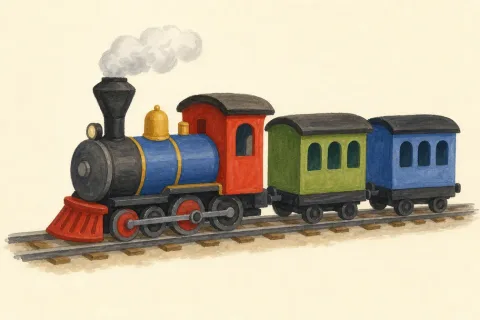
Start with what they can see
A study of English, Cantonese and Mandarin learners aged eight to sixteen months found that babies’ first words had much in common across languages, though the share of names for things, people words and action words differed between languages.1
German has a study of its own. Researchers recorded 32 German-speaking children at four ages, from thirteen months to three years, and found that at first the children mostly used what the authors call personal-social words, such as hallo and ja (yes), and relational words, such as da (there), plus a few sound words.2 Names for things, action words and small grammar words joined gradually, and by three the mix was balanced; the authors questioned the idea that early words are mostly names for things.2 So small everyday words earn a place from the start, next to people, food and things in the room: Danke (thank you), fertig (done), Noch mehr, bitte (more, please).
Five to try: Milch (milk), Mama, Papa, Ball, Auto (car). A favorite toy or a different food can take the place of one your family rarely uses.
Words in both languages count. Bilingual children are no more likely than other children to have trouble with language, and with both languages counted together they know about as many words as children learning one.3 An evaluation should look at every language a child uses.3, 4 The standard parent word checklist also has a German version, FRAKIS, with age norms from 1,240 children aged eighteen to thirty months and a 102-word short form made for well-child checkups in Germany.5 So a check can happen in German too. The bilingual toddler guide explains more.
How German sounds and reads
German spelling is far more regular than English, so once a few letters are familiar, most words sound the way they look. The native voice is still the best guide. A few things to look and listen for:
- A capital letter on every noun. German writes every noun with a capital, which is why the tables say Hund, Katze and Milch. Action and describing words stay lowercase: essen (eat), fertig (done), glücklich (happy). Zähne putzen (brush teeth) has both: the teeth are a noun, the brushing is not.
- The umlauts. ü is an “ee” said with the lips rounded for “oo”, as in Küche (kitchen), where it is usually short. ö is the “e” in “bed” with the same round lips, as in Löffel (spoon). ä is close to the “e” in “bed”, drawn out in Teddybär (teddy bear).
- Two kinds of ch. After a, o, u and au, it is the throaty sound in the Scottish “loch”, as in Nacht (night) and the noch of Noch mehr, bitte. After other vowels and after l, n or r, it is softer, like the “h” in “huge” with more breath: Milch, glücklich, ich. Many speakers use the same soft sound for a final -ig, so fertig can sound like “fertich”; in the south, Austria and Switzerland it ends in a “k”.
- sch, and sp and st at the start. sch is the English “sh”: Schuh (shoe), Schiff (ship). At the start of a word, sp and st begin with “sh” too: springen (jump) sounds like “shpringen”, and Stirn (forehead) starts “sht”.
- The German r. Most speakers make it at the back of the throat, a little like a soft gargle, as at the start of Regenbogen (rainbow). After a vowel it often fades toward “uh”, so Dinosaurier (dinosaur) ends close to “-ree-uh”. In parts of southern Germany, Austria and Switzerland it is often rolled instead; both are German.
- w and z. w is an English “v”, so Willst du spielen? (do you want to play?) begins “vilst”. z is “ts”, even at the start of a word: Zug (train) sounds like “tsook”, rhyming with “spook”, and zwei (two) like “tsvy”, rhyming with “fly”.
- ei, ie and eu. The second letter’s English name is the sound: ei says “eye”, as in zwei, and ie says “ee”, as in spielen. eu is “oy”: Freund (friend), Feuerwehrauto (fire truck).
- A final e that is spoken. Unlike the e in “cake”, it is heard: Katze (cat) sounds like “KAT-suh”, and Banane ends in a soft “nuh”.
The 75 words
These are the free words from Their First Words in German, in the three stages the app uses. Every word has two native voices, a woman’s and a man’s, so you can hear it before trying it yourself. The same 75, plus 35 everyday phrases, are also free printable German flashcards, with English as an optional second language. There are Spanish and Korean versions of this list too.
Voice for every card on this page:
First Words 0–24 months · 25 words
| German | English | Hear it |
|---|---|---|
| Hund | dog | |
| Katze | cat | |
| Ente | duck | |
| Milch | milk | |
| Banane | banana | |
| Hand | hand | |
| Löffel | spoon | |
| Schuh | shoe | |
| Ball | ball | |
| Teddybär | teddy bear | |
| Auto | car | |
| Zug | train | |
| Baum | tree | |
| Blume | flower | |
| Park | park | |
| Mama | mama | |
| Papa | dada | |
| Baby | baby | |
| essen | eat | |
| umarmen | hug | |
| rosa | pink | |
| zwei | two | |
| Herz | heart | |
| glücklich | happy | |
| fertig | done |
Growing Words 2–3 years · 25 words
| German | English | Hear it |
|---|---|---|
| Pinguin | penguin | |
| Dinosaurier | dinosaur | |
| Delfin | dolphin | |
| Pizza | pizza | |
| Stirn | forehead | |
| Küche | kitchen | |
| Sonnenbrille | sunglasses | |
| Puzzle | puzzle | |
| Feuerwehrauto | fire truck | |
| Schiff | ship | |
| Regenbogen | rainbow | |
| Meer | ocean | |
| Berg | mountain | |
| Zoo | zoo | |
| Burg | castle | |
| Freund | friend | |
| malen | painting | |
| springen | jump | |
| klettern | climb | |
| Zähne putzen | brush teeth | |
| lila | purple | |
| elf | eleven | |
| Raute | diamond | |
| aufgeregt | excited | |
| sanft | gentle |
Word Builder 3–5 years · 25 words
| German | English | Hear it |
|---|---|---|
| Pfau | peacock | |
| Zucchini | zucchini | |
| Gehirn | brain | |
| Magnet | magnet | |
| Taschenlampe | flashlight | |
| Aquarium | aquarium | |
| Uniform | uniform | |
| Trampolin | trampoline | |
| Raumschiff | spaceship | |
| Rennwagen | race car | |
| Globus | globe | |
| Vulkan | volcano | |
| Iglu | igloo | |
| Astronaut | astronaut | |
| Wissenschaftlerin | scientist | |
| Künstlerin | artist | |
| Prinzessin | princess | |
| Superheld | superhero | |
| so tun als ob | pretend | |
| sich entschuldigen | apologize | |
| lavendelfarben | lavender | |
| zwanzig | twenty | |
| Würfel | cube | |
| stolz | proud | |
| dazwischen | between |
Der, die, das: the short version
German has three words for “the”: der, die and das. Every noun has its own, and for most things it simply has to be heard: it is das Baby for any baby. For the five to try: die Milch, die Mama, der Papa, der Ball, das Auto.
The cards show the noun alone, because the article changes shape inside a sentence. For a toddler, the noun alone is plenty. For a parent learning German, a noun learned with its article, der Ball rather than Ball, comes with the hard part already done.
Long words and little words
German builds long words by joining short ones, and toddlers meet them early. Teddybär is a Teddy and a Bär (bear); Sonnenbrille is built from Sonne and Brille, sun and glasses; Rennwagen is a Wagen (car) for racing. Some grow out of words in the tables: Auto in First Words becomes Feuerwehrauto in Growing Words, and Schiff becomes Raumschiff in Word Builder. The stress usually falls on the first part, and the picture does the explaining. A long word also takes the article of its last part: das Auto, so das Feuerwehrauto.
German also has a small-and-sweet ending, -chen or -lein, which often adds an umlaut: Katze becomes Kätzchen (kitten), and Andersen’s ugly duckling is das hässliche Entlein. Every one of these is a das word, whatever it started as: die Katze, but das Kätzchen. In Swiss German the ending is often -li.
Phrases, du and family words
German has two ways to say “you” to one person: du for family, friends and children, and Sie, the polite form for adults outside that circle. The phrase cards all use du, because that is what a small child says and hears. Sie can wait.
| German | English | Hear it |
|---|---|---|
| Noch mehr, bitte. | More, please.a child says it | |
| Ich bin fertig. | All done.a child says it | |
| Danke. | Thank you.a child says it | |
| Ich hab dich lieb. | I love you.a child says it | |
| Das ist meine Mama. | This is my mommy.a child says it | |
| Willst du spielen? | Do you want to play?a child says it to a friend | |
| Gib mir deine Hand. | Hold my hand.a grown-up says it | |
| Gute Nacht, schlaf schön. | Good night, sleep tight.a grown-up says it |
- Ich hab dich lieb is the family “I love you”, for children, parents and grandparents; Ich liebe dich belongs mostly to couples. The card says hab, as parents do, rather than the textbook habe.
- Gib mir deine Hand is a German parent’s line at the curb: literally “give me your hand”. Gib mir die Hand is common too.
- Danke usually gets bitte in reply, the same word as the “please” in Noch mehr, bitte.
- fertig means both “done” and “ready”, so it fits the end of a meal (Ich bin fertig) and the moment the shoes are on.
Mama and Papa are everyday words at any age, not baby talk; many adults keep using them with their own parents. You may also hear Mami and Papi, pet forms of the same words. Grandparents are Oma and Opa. Das ist meine Mama (this is my mommy) uses meine, the “my” that goes with a die word; with der Papa it becomes mein, as on the card Das ist mein Papa (that’s my daddy).
Using them in an ordinary day
A few German words can fit into a routine you already have:
- Breakfast: Milch (milk), Banane, Löffel (spoon), and Noch mehr, bitte (more, please) when the bowl is empty. The mealtime guide walks through exactly this.
- Getting dressed: Schuh (shoe), Hand, and fertig (done) when the shoes are on.
- The park: Park, Baum (tree), Blume (flower), Ente (duck), Ball.
- Bedtime: Teddybär (teddy bear), Zähne putzen (brush teeth), and Gute Nacht, schlaf schön (good night, sleep tight) at lights-out.
Naming what your child is already looking at is a good way in. In a classic study, toddlers learned new words better when an adult named the thing they were already attending to than when the adult tried to steer their attention somewhere else.6 So: “Ente” when they spot a duck, then a few seconds for a reply. A point, a sound or “duck” keeps the exchange going; you can answer with the German word again. A sentence that starts in German and ends in English is a normal part of learning both.4 The two-language card routine shows how that can work with a picture beside the real meal.
Grandparents, Saturday school and learning parents
For many families, German is the language of grandparents in Germany, Austria or Switzerland, and a video call is where it shows. A toddler with something to say on cue helps that call: Ich hab dich lieb (I love you), Danke (thank you), or Das ist meine Mama (this is my mommy) when Mom leans into the frame. The cards use the standard German of Germany. Austrian and Swiss grandparents may say some things differently (in Austria, a tomato is often a Paradeiser; in Switzerland, zucchini are often Zucchetti), and their words are worth keeping alongside the cards.
A German Saturday school or a bilingual preschool, where there is one nearby, adds hours and voices. In a study of twenty-nine Spanish–English two-year-olds, the share of the day each language filled predicted how each was coming along, and for English, so did the number of different people the child heard it from.7 Each grandparent, teacher and friend adds time in German and another voice. In between, a minute with four cards at breakfast is not homework.
When only one parent speaks German, the other voices matter more. In a survey of 1,899 families with children aged six to ten, in which at least one parent spoke a minority language, children had a high chance of speaking it when both parents used it and no more than one also spoke the community language; “one parent, one language” was neither necessary nor sufficient.8 The other parent does not need to switch; the AAP’s advice is to use the language you are most comfortable in.4 Knowing Mama, Papa and Noch mehr, bitte well enough to answer them is a warm way to join in.
Some families choose German with no German speaker at home, for family history or for love of the language. The native voices give you the word to copy, and a Saturday school or playgroup adds people who grew up speaking it. The guide to teaching a language you don’t speak covers how far that can go. And if your own German went quiet after childhood, you are in common company: home languages are more likely than the community language to fade as children grow.3
Paper, app, or both
The printable cards are free, with no sign-up, and can live on the fridge or beside a favorite book. The app starts with the same free words and phrases, with a woman’s and a man’s native German voice on every card, no ads, and offline play. A switch of the language pill turns Milch into milk on the same picture. One $9.99 purchase opens the rest of the 1,000+ words and 500+ phrases, in all eight languages. The card is the prompt; the conversation is yours. Neither is a treatment for language delay. You can come back to this page whenever you want to hear a word again.
In short
Questions parents ask.
What German words should a toddler learn first?
Familiar people, food and everyday things are useful starting points: Mama, Papa, Milch (milk), Banane, Ball and Schuh (shoe), with a few small words such as fertig (done) and Danke (thank you) alongside. In a study that recorded German-speaking toddlers, the first words were mostly social words such as hallo and ja (yes) and small words such as da (there), with names for things joining gradually. Words for things your child notices give you something to talk about together.
Can I teach my toddler German if I don’t speak it?
You can give a real start. A few routines in German, such as breakfast, getting dressed and bedtime, need only a handful of words, and the native voices on this page give you each one to copy. At least one person or place where German is spoken natively, such as a grandparent on a video call, a playgroup or a Saturday school, adds what a learning parent cannot. A few real exchanges a day is a fine goal; fluency is not the bar.
Will German at home slow down my toddler’s English?
No. Learning more than one language does not cause a speech or language problem, and an evaluation should consider every language your child uses. Counted across German and English together, bilingual toddlers know about as many words as toddlers learning one language. A word in either language counts.
What if only one of us speaks German?
It can still work. In a large survey, children had a high chance of speaking the home language when both parents used it and no more than one also spoke the community language; “one parent, one language” was neither necessary nor sufficient. In a mixed home, the German-speaking parent’s time, plus grandparents, friends and Saturday school, carries more of the weight. The other parent can keep to the language they are most comfortable in; knowing Mama, Papa and Noch mehr, bitte (more, please) well enough to answer them is a warm way to join in.
What this is based on
Sources
- Tardif, T., Fletcher, P., Liang, W., Zhang, Z., Kaciroti, N. & Marchman, V. A. (2008). Baby’s first 10 words. Developmental Psychology, 44(4), 929–938. PMID 18605825
- Kauschke, C. & Hofmeister, C. (2002). Early lexical development in German: a study on vocabulary growth and vocabulary composition during the second and third year of life. Journal of Child Language, 29(4), 735–757. doi:10.1017/S0305000902005330
- Byers-Heinlein, K. & Lew-Williams, C. (2013). Bilingualism in the early years: what the science says. LEARNing Landscapes, 7(1), 95–112. PMC6168212
- AAP and ASHA, Young Children Learning Multiple Languages: Parent FAQs (updated November 2025) — a speech or language problem shows up in every language; mixing is normal; use the language you are most comfortable with. healthychildren.org
- Szagun, G., Stumper, B. & Schramm, S. A. (2023). Fragebogen zur frühkindlichen Sprachentwicklung: FRAKIS (Langform) und FRAKIS-K (Kurzform), 2nd ed. Universität Potsdam — the German adaptation of the MacArthur-Bates CDI for ages 18–30 months, normed on 1,240 children. doi:10.25932/publishup-58675
- Tomasello, M. & Farrar, M. J. (1986). Joint attention and early language. Child Development, 57(6), 1454–1463. PMID 3802971
- Place, S. & Hoff, E. (2011). Properties of dual language exposure that influence 2-year-olds’ bilingual proficiency. Child Development, 82(6), 1834–1849. PMC4144198
- De Houwer, A. (2007). Parental language input patterns and children’s bilingual use. Applied Psycholinguistics, 28(3), 411–424. doi:10.1017/S0142716407070221
Simple Words, Special Moments
Start with one word.
75 words and 35 phrases are free, forever, with both voices. One $9.99 purchase opens the rest of the 1,000+ words and 500+ phrases, in all eight languages at once. No subscription, nothing renews.
More guides
Keep reading.
 Can I teach my child a language I don’t speak?Why your accent is probably not the worry, what a native speaker adds, and how a few real exchanges a day can start a second language.Read the guide · 8 min ›
 Raising a bilingual toddler: what the research says.Why mixing is normal, how vocabulary grows, and where two languages fit into family life.Read the guide · 7 min ›
 A two-language card routine for an ordinary meal.Milk, banana, spoon and More, please: four cards for an ordinary meal in two languages.Read the guide · 5 min ›
Choosing an app? Our guides to the best first words app for bilingual families and the best English app for toddlers with another home language.