Home › Guides › Are flashcard apps bad?
A fair question, answered straight
Are flashcard apps bad for toddlers? An honest answer.
Used as a quiz, or handed to a child alone all afternoon, yes. Used as a picture you name together, no. Here is where the critics are right, where they stop, and where a phone honestly fits in a real parent’s day.
The short answer
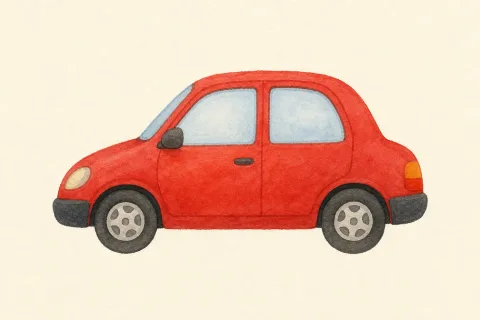
A flashcard app is bad for a toddler when it does three things: quizzes the child, stands in for a parent all afternoon, or promises that a screen will teach a baby to talk or read. The research behind the criticism is about exactly those things, and it is right.1, 2, 3, 4, 5
The same picture used the other way, named warmly by a parent while a child looks at it for a minute or two, is a picture book with one page. No study we know of says that is harmful. What the research does say is that the talking is what matters, and that it comes from a person.1, 2
In one line: the problem is the quiz, not the card. An app that never asks your child a question, never talks at them through a character, and leaves the advancing to you unless you turn on Auto Play is on the right side of that line. Ours is built that way.
What the critics get right
Drilling a toddler is backwards
Hold up a card, ask “what’s this?”, wait for the answer. For a toddler that is a test, and tests are not how early words arrive. In a well-known study of joint attention, children learned words more successfully when an adult named what they were already looking at, rather than steering them to something else.1 And beyond how much a parent talks, how richly they talk, with varied words and later with stories and explanations, predicts a larger vocabulary a year on.2 A drill is the opposite of rich talk.
In one experiment, babies learned a speech sound from a person, not a recording
Nine-month-olds who heard Mandarin from a live person in the room learned to hear a Mandarin sound contrast. Babies who got the same material on video or audio did not show that learning.3 It was one sound contrast in one study, not a verdict on every recording. But it is a good reason to treat a recorded voice as a pronunciation example for you, not a teacher for your baby.
“Baby media” did not deliver what it promised
A randomized trial gave 117 infants aged nine to eighteen months a best-selling baby-media program of DVDs, word-and-picture flashcards and word books, used daily for seven months. The babies did not learn to read. The one thing that did differ between the groups was what the parents believed: they thought their child was learning new words.4 An earlier trial of a popular word-teaching DVD with 12- to 18-month-olds found the same shape. Babies who watched it learned no more words than babies who did not, parents who taught the same words in everyday life got the most learning, and parents who liked the DVD overestimated what their child had picked up.5 Any company selling cards to parents of babies should be measured against those studies, ours included.
A screen is a screen
The World Health Organization recommends no sedentary screen time before age two and no more than an hour a day for ages two to four, with less preferred.7 The American Academy of Pediatrics’ 2026 policy puts quality and context ahead of a daily minute count and asks about the child, the content, whether it is used to calm a child, what media crowds out and how the family talks about it; it notes that babies under 18 months have trouble carrying what they see on a screen into the real world, and it encourages parents to watch and play alongside young children rather than leave them to it.6 An app on a phone is inside all of that guidance, including ours. See our screen-time guide for the studies in detail.
A tired parent reaching for a phone is not a learning program
True. We will come back to this, because it is the part most pages skip.
Where the criticism stops
Every objection above is about method: quizzing, leaving a child alone with it, promising outcomes. None of it is about a picture of a dog. A board book, a card on the fridge and a card on a phone are all props. The question that matters is who is talking, and whether they stop when the child turns away.
So here is the line we hold. The app never asks your child a question. No character talks at them. With Auto Play off, each card stays until you choose Next, and the native voice exists so you can hear a word in Spanish or Korean once and then say it yourself, looking at your child. Turn Sound off if you want to do all the naming yourself. Interaction is the point. The app does not replace everyday conversation in your family’s languages, and it is not supposed to. It is a prompt for that conversation, and a pronunciation model when the word is in a language you do not speak.
Books are wonderful. When you have the energy, nothing beats a page you point at together. The rest of the day, use whatever gets the two of you talking.
We are parents too. Energy is finite.
It is 6 pm. One child is hungry, the other is on your hip, dinner is half made, and you would like them to hear some Portuguese today because their grandmother speaks it and you do not. The picture books are in the other room. The phone is in your pocket.
That is why an app like this exists: not to replace the conversation, but to make it cheap enough to start. What a phone lowers the cost of, honestly:
- A language you do not speak. A native voice, a woman’s and a man’s, for the word you want to say but cannot pronounce. You copy it, then you say it.
- Two languages on one picture. The same drawing of milk carries leche or leite with a quick switch, so a bilingual home does not need two sets of cards.
- No sorting. Food words before you cook, animal words on the way to the zoo, already grouped, already illustrated, in your pocket.
- Two minutes count. One picture named together on the sofa is a real moment. It does not need to be a session.
The phone can start the moment, and the moment can leave the phone: the word again at the sink, a point at the real banana. That is what the research is asking for.
And some days the phone is the moment, and that is fine. Raising a child is hard. Teaching one is harder. You are allowed to use the tool in your pocket, and you do not owe anyone a perfect afternoon.
Auto Play, honestly: a crutch for the car and the airplane
Our app has an Auto Play mode, and we are not going to hide it. Here is exactly what it does. It is off by default. When you turn it on, the card shows one picture, a native voice says the word in the language you chose, the card rests for five seconds, and the next one comes. On (Loop) starts over at the end. The screen stays on during a session. Lock ignores stray taps, and you open it by pressing and holding for two seconds. There are no reward sounds, no points, no character, nothing that asks the child to do anything.
When would we use it? The back seat on a long drive. A waiting room that is running forty minutes late. Row 23 on a four-hour flight. Places like those, the moments every parent has, when you cannot be the one doing the naming and something is going to fill the gap anyway. In those minutes we would rather our daughters heard “pato” over a calm watercolor duck than almost anything else a phone offers a two-year-old.
A crutch gets you through a hard stretch. That is why it is off by default and the choice is yours. Nobody is keeping score, least of all us.
What we refuse to build
- No quiz. The app never asks your child a question or scores an answer. Mark Learned is a bookmark for you, not a grade for them.
- No character talking at your child. The voice you hear is a native voice saying one word, so the voice your child learns from can be yours.
- No streaks, reminders or reward sounds. Nothing nags you back and nothing rewards a child for staying longer.
- No ads, and nothing sold inside the app to a child. One purchase by a parent, once.
- No promises. We have no evidence that Their First Words makes a child talk sooner, and we do not claim it. It is not a screener and it does not treat a delay. If something feels off, your pediatrician or a speech-language pathologist is the right call, and asking early costs nothing. See when to ask for help.
If you use one, use it like this
- Follow their eyes, then name it. Let the child pick the picture. Say the word warmly. No need to ask them to say it back.1
- Play the voice, then use yours. The native voice is a model for you; the back-and-forth comes from the person in the room.3
- Let them be done. Meals, bedrooms and the hour before bed are easy times to skip the phone.6
- Keep paper nearby. Our free printable cards are the same pictures with no screen at all.
The five suggestions in full, with the research behind each one, are in how to use flashcards with a toddler.
In short
Questions parents ask.
Are flashcard apps bad for toddlers?
They are bad when they quiz a child, run on their own all afternoon, or promise to teach reading or talking. A picture a parent names and talks about together for a few minutes is a different thing. The research criticizes drilling and screens used alone; it does not say a shared picture is harmful.
Do flashcards help babies talk?
There is no good evidence that flashcards by themselves make a baby talk sooner, and a large body of evidence that back-and-forth talk with a person builds vocabulary. Cards can be a prompt for that talk. They are not a program, a screener or a treatment.
Do flashcards cause speech delay?
We know of no study that tested flashcards and found a delay. The evidence of harm is about hours of screen time, especially alone or in the background, and most of it is correlational. The honest statement is narrower: there is no evidence that drilling helps, and the time it takes is time not spent talking.
Is it okay to put flashcards on Auto Play for my toddler?
In places like a car seat, a waiting room or an airplane, yes, in our view. One picture, one word in a native voice, a quiet rest, the next one, no reward sounds and no character. It is off by default, and it is there for the stretches when you cannot do the naming yourself.
Can a flashcard app teach my child a language I don’t speak?
It gives you a native voice to copy and a picture to talk about, which beats guessing pronunciation from spelling. A child learns a language from the people who speak it around them, and we have not tested whether using the app teaches one. Treat it as a prompt and a pronunciation model, not a teacher.
Are paper flashcards better than an app?
For a lot of homes, yes, and ours are free to print. An app earns its place where paper cannot: a native voice in a language you do not speak, one picture that carries two languages, categories you do not have to sort, and the fact that the phone is already in your pocket. Use whichever one you will actually pick up.
What this is based on
Sources
- Tomasello, M. & Farrar, M. J. (1986). Joint attention and early language. Child Development, 57(6), 1454–1463. doi:10.2307/1130423
- Rowe, M. L. (2012). A longitudinal investigation of the role of quantity and quality of child-directed speech in vocabulary development. Child Development, 83(5), 1762–1774. doi:10.1111/j.1467-8624.2012.01805.x
- Kuhl, P. K., Tsao, F.-M. & Liu, H.-M. (2003). Foreign-language experience in infancy: effects of short-term exposure and social interaction on phonetic learning. PNAS, 100(15), 9096–9101. pnas.org
- Neuman, S. B., Kaefer, T., Pinkham, A. & Strouse, G. (2014). Can babies learn to read? A randomized trial of baby media. Journal of Educational Psychology, 106(3), 815–830. doi:10.1037/a0035937
- DeLoache, J. S., Chiong, C., Sherman, K. et al. (2010). Do babies learn from baby media? Psychological Science, 21(11), 1570–1574. doi:10.1177/0956797610384145
- American Academy of Pediatrics (2026). Digital Ecosystems, Children, and Adolescents: Policy Statement. Pediatrics, 157(2), e2025075320. doi:10.1542/peds.2025-075320
- World Health Organization (2019). Guidelines on physical activity, sedentary behaviour and sleep for children under 5 years of age. who.int
More guides
Keep reading.
 When do babies say their first words?Around the first birthday for many children. What to notice and when to ask.Read the guide · 6 min ›
 Raising a bilingual toddler: what the research says.What the research says about two languages at home, and how to make it work.Read the guide · 7 min ›
 How to use flashcards with a toddler (without turning it into a quiz).Five suggestions for sharing cards without a quiz.Read the guide · 5 min ›
 Is my toddler a late talker? When to ask for help.Word counts can raise a concern; they cannot tell you whether your child needs support. Here is who to ask.Read the guide · 5 min ›
 Does a second language delay a child’s speech?No — and here are the studies to hand to whoever asked.Read the guide · 6 min ›
 How many words should an 18-month-old say?What the 18-month checklist can tell you, what it cannot, and when to ask.Read the guide · 3 min ›
 Screen time under two: what the research actually says.Current guidance, limits of the research, and how it applies to our app.Read the guide · 3 min ›
 A first words list by age.The categories that often come first across languages, and roughly when, from 12 months to 3.Read the guide · 7 min ›
 From a mealtime word to a useful phrase.Use four real cards, playable audio, and one printable sheet during a meal.Read the guide · 4 min ›
- A two-language card routine for an ordinary meal.A small English–Spanish meal routine with actual cards and recordings.Read the guide · 5 min ›
 First Spanish words for toddlers: 75 to start with.Seventy-five words by age and topic, each with a native voice to copy — and which five to start with.Read the guide · 6 min ›
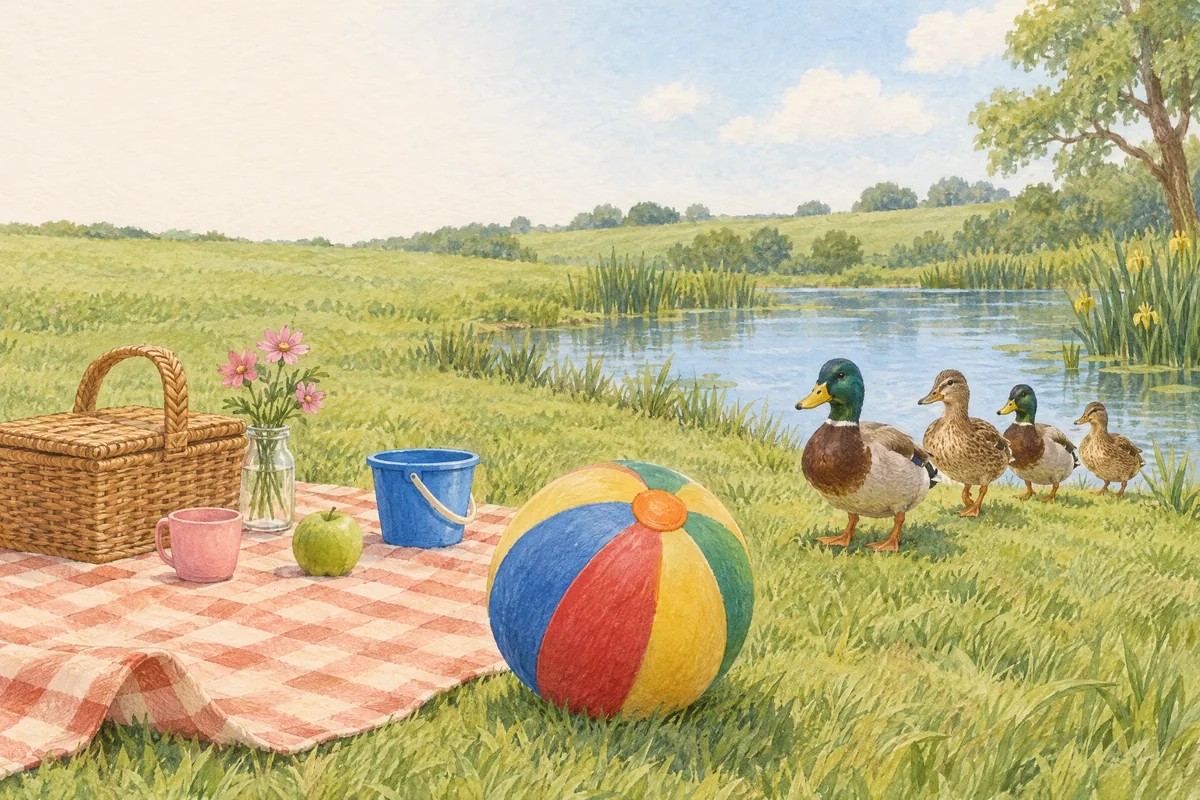 One little picnic: name it, count it, sort it.Four Spanish cards to hear and print, a count, a sort, and one short film — for one ordinary outing.Read the guide · 6 min ›
Simple Words, Special Moments
Start with one word.
75 words and 35 phrases are free, forever, with both voices. One $9.99 purchase opens the rest of the 1,000+ words and 500+ phrases, in all eight languages at once. No subscription, nothing renews.